Sunday, 17 October 2021

Course: Open Licensing

 Licensing your research outputs is an important part of practicing Open Science. In this course, you will:

  • know what licenses are, how they work, and how to apply them 
  • understand how different types of licenses can affect research output reuse
  • know how to select the appropriate license for your research


Saturday, 16 October 2021

10 YEARS OF OPEN ACCESS BOOKS AT DE GRUYTER – 10 WINNING TITLES!

We are happy to announce the winning titles of De Gruyter’s Open Access Book Anniversary competition!

In late 2020, to celebrate the 10th anniversary of our very first Open Access book publication and to support the open research movement we decided to start a call for book proposals. Winners would get their title published in Open Access at no cost to them. We asked academics worldwide, from all subject areas, to tell us about their monograph ideas, their envisioned audiences, and a little about themselves.

Within 10 weeks, we received almost 120 entries. An expert committee of renowned researchers from a variety of academic disciplines reviewed all of the submissions and ultimately had to make some hard choices.

We are now happy to announce the 10 winning titles:
Peter Brown: “Meteorological disasters in medieval Britain (AD 1000-1500): Archaeological, historical and climatological perspectives within a wider European context”
Alexandra Chiriac: “Performing Modernism. A Jewish Avant-garde in Bucharest”
Özkan Ezli: „Narrative der Migration. Eine andere deutsche Kulturgeschichte“ (Narratives of Migration: The Other History of German Culture)
Dominique Haensell: “Making Black History. Diasporic Fiction in the Moment of Afropolitanism”
Katrin Kleemann: “A Mist Connection. An Environmental History of the Laki Eruption of 1783 and Its Legacy”
Michael Navratil: „Kontrafaktik der Gegenwart. Politisches Schreiben als Realitätsvariation bei Christian Kracht, Kathrin Röggla, Juli Zeh und Leif Randt“ (Counterfactual Fiction of the Present: Political Writing as a Variation on Reality in Christian Kracht, Kathrin Röggla, Juli Zeh, and Leif Randt).
Frank Ejby Poulsen: “A Cosmopolitan Republican in the French Revolution: The Political Thought of Anacharsis Cloots”
Frédérique Renno: „Die deutschsprachige weltliche Liedkultur um 1600“ (Worldly Lied Culture in German around 1600)
Atle Ottesen Søvik: “A Basic Theory of Everything: A Fundamental Theoretical Framework for Science and Philosophy”
Lena Zschunke: „Engel in der Moderne. Eine Figur zwischen Exilgegenwart und Zukunftsvision“ (The Angel in Modernity. A figure between exiled presence and future vision)

The winners will receive an immediate Open Access publication available on www.degruyter.com plus services such as indexing and distribution. The books will also be available as print editions.

We will furthermore present the winning titles via short author interviews on our blog De Gruyter Conversations, starting with Dominique Haensell and her title “Making black history”. Dominique Haensell is editor-in-chief of the feminist Missy Magazine.

You can find further information on the competition here.

F1000 Research is now open to all disciplines, including Humanities and Social Sciences


(Image Source: https://twitter.com/f1000research)


Open research publisher F1000, is delighted to announce that it has now extended its trailblazing publishing offering on its own publishing platform, F1000Research, into all subject disciplines, with the latest addition of Humanities, Social Sciences, Physical Sciences and Engineering completing the line-up.

Launched in 2013, F1000Research pioneered the ‘post publication, open peer review’ open research model, initially piloting this novel way of publishing with scholars from across life science and medicine, due to their greater appetite for Open practices at that time. As confidence, opinion and adoption of open research grew, so did F1000Research’s reach into other disciplines such as the Natural Sciences, Agricultural and Veterinary Sciences. Completing the set are Humanities and Social Sciences (HSS), Physical Sciences and Engineering (PSE), which have launched today.

Rebecca Lawrence, Managing Director of F1000 said:

“The vision behind F1000 has always been to develop approaches to scholarly publishing that better support the needs of today in communicating new findings. We started our quest within the fields of Life Sciences and Medicine but have long been keen to apply similar thinking and the benefits open research brings to all research disciplines. By listening and responding to the needs of the community, as well as learning from our external partners and our colleagues at Taylor & Francis who bring strengths in knowledge across the disciplines, we are delighted to now expand F1000Research’s reach into the Humanities, Social Sciences, Physical Sciences and Engineering. We are excited to be able to extend our tools and services to facilitate and support this enhanced knowledge sharing across the disciplines to help keep the authors and the research community at the centre of the research and dissemination process.”

In recognition of the different needs that the HSS and PSE communities have in conducting and publishing their research, we recently launched two new article types on F1000Research: Policy Briefs and Case Studies. These new article formats expand on F1000Research’s already impressive range of research outputs on offer, such as data notes, method articles and software tools. Researchers are also able to publish other outputs that may not warrant full peer review, but that are still important and valuable outputs of their research such as technical reports, whitepapers, training materials, conference slide sets, etc to support citation, recognition and credit for those outputs and to ultimately aid reproducibility.

Guillaume Wright, Publisher PSE at F1000 said: “We’re delighted that F1000Research is now a genuine partner for those working across the physical sciences and engineering scholarly communities, helping to shape the future of open research by supporting their aspirations to make their work as accessible, reproducible and transparent as possible. We’re excited to collaborate with those who share our vision to drive a real shift towards open research, benefitting not just those academics who choose to take advantage of our innovative, high-quality and rapid publishing model, but also benefitting society and the broader research community in the process.”

Gearoid O Faolean, Publisher HSS at F1000 said: “F1000Research’s drive to work with and support scholars in the arts, humanities and social sciences is a fantastic step forward for researchers in this area. The speed, transparency and accessibility that we offer on our publishing platform will enable those researchers to publish all of their research outputs as openly and rapidly as possible in a high-quality venue. While the concepts of open peer review and open data may be novel to some scholars in these areas, I look forward to seeing how the researchers will engage with and benefit from such practises.”

Visit F1000Research to browse through the latest research published across all disciplines: HTTPS://F1000RESEARCH.COM/
About F1000

F1000 fosters a culture of innovation to accelerate the reach of knowledge and put it in the hands of those who will shape the future.

We provide open research publishing solutions and services to organizations such as the European Commission, Wellcome, and the Bill & Melinda Gates Foundation, as well as directly to researchers through our own publishing platform, F1000Research.
F1000 is wholly owned by the Taylor & Francis Group, an Informa Group company.

Website: HTTPS://F1000.COM/ | Twitter: @F1000
About F1000Research

F1000’s own publishing platform, F1000Research, was launched in 2013 and pioneered the ‘post-publication peer review’ publishing model, offering immediate publication and transparent peer review. Articles are published first (as they would be on a standard preprint repository) and peer-reviewed after publication by invited referees, whose names and comments are made visible by default on the website alongside the research.

The data behind each article is also published open access and free to download. F1000Research publishes both traditional research articles, but also single findings and snippets of information such as case reports, protocols and experiment replications. Importantly, it welcomes the publication of null or negative results – consciously shifting away from the culture of only publishing work deemed to be headline-grabbing or of mainstream interest, as well as accelerating the pace of discovery, providing credit and recognition for authors, and importantly, improving public trust in research.

Website: HTTPS://F1000RESEARCH.COM/ | Twitter: @F1000RESEARCH
Contact

Martha Attard Gialanze,

Communications Manager,

Email: MARTHA.ATTARDGIALANZE@F1000.COM

Monday, 1 March 2021

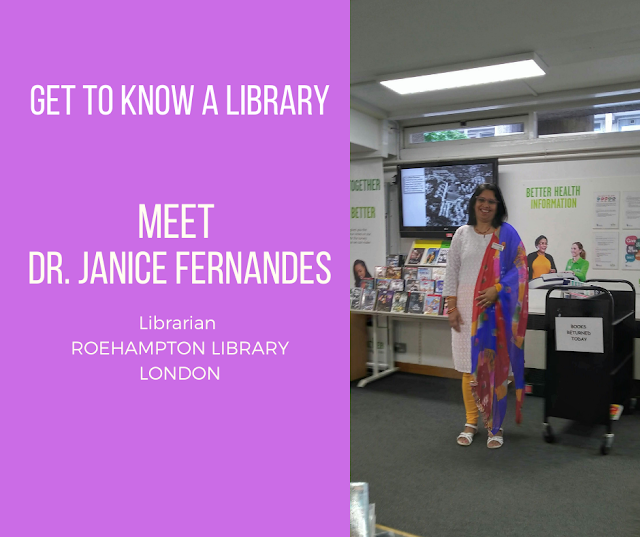
Get to Know a Library: Meet Dr. Janice Fernandes #2

Get to Know a Library

Roehampton Library is a public library nestled in the local communities and caters to a wide
and diverse range of customers from Putney , Roehampton and Barnes.
The library welcomes toddlers, little children , school and college goers , students from the
University of Roehampton, adults and older residents in the true spirit of equality and
diversity. We also welcome the physically and mentally challenged and strive to make their
visits comfortable, fruitful ad satisfactory.
Various events and activities carefully planned and implemented by Roehampton Library all
through the year both in the physical space as well as in the digital environment are focussed
on community participation, skill building, leisure and entertainment and knowledge growth
and sharing.
Below is a brief overview of the events and activities undertaken at Roehampton Library -
1. The need and importance of sing and reading to children and with children can never be
over emphasised. The correct tone, pronunciation, phonetics and intonation helps them
build a rich vocabulary and develop a love of reading. To this end the library has weekly
Rhyme Time and Story Time sessions. Additional assistance is provided through after
school Reading Support Club.
2. Saturday clubs, Colouring and craft activities and Dad’s story time attract a lot of
participants. Board games like chess, scrabble, word building etc provide intellectual
stimulus.
Innovating Libraries: Roehampton Library, London


3. Summer Reading Challenge is initiated every year at the beginning of the summer
holidays. Every attendee has to read 6 books and talk about them. Stickers, prizes and
medals are awarded.
4. Various schools and nurseries in the surrounding area bring children to the library for
Class visits, story telling, curriculum support and book selection. This is implemented
with the school literacy co-ordinator so that a properly structured timetable is in place.
5. Various after school club activities like Coding Club, Science Club, Homework Club
etc. are in place during term time.
6. The library successfully organises ESOL classes (English for Speakers of Other
Languages) The duration of the courses is generally 72-84 hours with examinations and
certification at the end. English conversation classes also take place on a weekly basis.
7. Two hour public computer use is offered to library members every day. To support this
I.T. training classes and held on general as well as specific topics for the adults and
older residents.
8. Book Clubs, Reading Groups, Poetry Groups and Knit and Natter Clubs are held
fortnightly. It gives the local community and opportunity to gather together, participate
and learn new ideas.
Innovating Libraries: Roehampton Library, London
9. Exhibitions, Workshops, Talks, Oral History projects, Good health and Well being
lectures are held on different occasions throughout the year.
10. The month of October is celebrated as Black History Month. Various artists, authors
and organizations visit the library though pre-planned projects, workshops and
interactive sessions.
11. Special events are organised for special days like Holocaust Memorial Day, Poppy Day,
Library Week, Term Breaks and Festival days.
12. The library offers its space, furniture, computers and resources to any organization or
individual who might want to run an event for the good of the community.
13. Local councillors and MPs use the library space to interact with residents every Saturday.

Dr. Janice Fernandes is a Librarian with Roehampton Library, London for the past three years. She has been proactive in Information Literacy sessions as she feels customer service is the core of any library. She is gifted with excellent communication and presentation skills. As such she is constantly upskilling herself and her library users with team building activities.


Note: All the photos included in this blog post have the copyright of Roehampton Library, London.

Cite as:
Bhange, C. (2021). Get to Know a Library: Roehampton Public Library [Blog]. Retrieved from https://chinmayeebhange.blogspot.com/2021/03/get-to-know-library-meet-dr-janice.html

Thursday, 18 February 2021

DSpace for academic libraries - Part 1


Chinmayee Bhange

DSpace is an Open Source Software package which is most commonly used by institutions to archive and make accessible scholarly content created or generated by the institute. The content may range from born digital items to scanned copies.

It was released in the November of 2002 by Duraspace. Currently, it has version 6.3 ready for download using GitHub. It uses JAVA for programming. For more details, please visit https://duraspace.org/dspace/


DSpace is a repository making software which is freely available for download and customization. It is used to collect and preserve the published articles, white papers, working papers, reports, data sets, edited books and such other scholarly content of the institute in one place.

The various sections or topics in DSpace are referred to as a Community. A Community has sub-communities. So, for example, a community can be the Department of Computer Science. The Sub- Community under this Community can be Books, Journal Articles, etc.

Essentially, a Community is the broad group which can be further categorised as per the need or ease of retrieval.

These Communities have e people and e groups who are the admin or super admin of the groups. Which means they have the right to upload data (content) and allow or dis-allow access to specific people or user groups. This is the Administrator – Control interface.

In SFIT LIRC, we have been DSpace for many years now. Based on the need and intended use, we have created the following communities in our DSpace@SFIT.

Creating Community:

        Each DSpace unit (or service) which we want to group together is comprised of Communities – the highest level of the Dspace content hierarchy

        Communities may be:

        Departments

        Labs   

        Research Centres

        Schools

        Each community contains descriptive metadata about itself and the collections contained within it

        Every community in turn have collections which contain items or files and contains Descriptive Metadata

Example from our LIRC at St.Francis Institute of Technology

Community

Sub-Community

Collection

Items

Approved Lists

Journals

UGC CARE

List 1


SCIMAGO Journal and Country Rankings

List 1


Example for any library to start with:

Community

Sub-Community

Collection

Items

Name of the Department

Publications

Books, Journals, Conference Proceedings

Soft Copies of Books, Journals, Conference Proceedings. Make sure you have the copyright to upload material!


Projects

Sponsored by Institute

Grants from GOI

Grants from AICTE

Working Papers, Models and Final Completion Certificates


1.     Sign in to DSPace using Administrator login

2.     Determine a name for your Top Level Community

3.     Go to “Communities and Collections”

4.     Click on “Create Community”

5.     Provide the required Metadata for your Community

6.     Set proper Authorization hierarchy or Access Rights

7.     Click on “Create”

8.     You can edit your Community and metadata at this stage too

9.     After editing, do not forget to click on “Update”

References:

https://www.ohiolink.edu/sites/default/files/uploads/CreateCommunities.pdf


An introduction to DSpace - ScholarSpace

scholarspace.manoa.hawaii.edu › bitstream › Module 3 .