Showing posts with label Innovating Libraries. Show all posts

Saturday, 21 October 2023

I-KOAL 2024 on 'Innovative Technologies and Applications for Sustainable Library Services' on February 15-16, 2024 at MITWPU, Pune


Source: Librarian of MITWPU, Pune

Library  Professionals Association (LPA) is organising I-KOAL 2024 on 'Innovative Technologies and Applications for Sustainable Library Services' on February 15-16, 2024 at MITWPU, Pune.

Theme: Innovative Technology and Applications for Sustainable Library Services

Sub-Theme: 
  • Knowledge Management
  • Research Data Management
  • Management of Digital Libraries 
  • Multimedia Content Management
  • Capacity Building & HR Management in Library Services
  • Sustainable Digital Library Model
  • Green Libraries: Concept & Processes
  • Public Library as Information & Cultural Hubs
  • Library Outreach, Marketing, and Advocacy in Digital Age
  • Modern Librarianship and Ethics
  • Emerging & Innovative Technology Applications in Libraries
  • Research Tools, Techniques and Methodologies
  • Open-Source Software application in Libraries
  • Smart use of Plagiarism Tools, IPR and Copyright in the Digital Age
  • Digital Library Consortia: Challenges and Future
  • Perspectives Role of Librarians and Libraries in Institutional Rankings
Important Dates:
December 31st, 2023 : Complete Paper Submission
January 10th, 2024 : Notification of Acceptance
January 15th, 2024 : Registration for Paper Submission

Wednesday, 3 May 2023

Resh Susan: Keep writing until you find your voice


Resh Susan or @thebooksatchel dwelled into journaling as a hobby way back in the year 2015. Her website and book reviews are an absolute treat to the eyes. Her posts are captivating. Hats off to her photography and the props!

Trust me, her website and Instagram handle are actually a "Satchel" - a mixed bag of reviews, pictures and her notes which simply add to the beauty of her writings.

Chinmayee Bhange interviews Ms. Resh Susan on the occasion of "Write a Review Day" which is celebrated on May 3.

Picture Courtesy: Resh Susan

Please tell us more about yourself.

Hi, I am Resh Susan. I run The Book Satchel (https://www.thebooksatchel.com/)and a monthly newsletter Satchel Notes (https://reshsusan.substack.com/)

How long have you been blogging? Tell us more about the idea behind "The Book Satchel"

The Book Satchel has been live since Dec, 2015. I was at a stressful time in my life and wanted an outlet for creative and bookish thoughts.

What genres of books do you generally follow and review?

I am a mixed bag. I enjoy a scary dystopian read as much as a pacy thriller or a literary read. I have a soft corner for magical realism. And I love a book that entertains.

According to you, what makes a good book? The plot or the author?

I try not to associate the person who wrote the book to the characters in the book. A book stands out by its plot, characters, language or structure. In short, a book should move the reader in some way.

How does a certain book achieve its "Best Seller" status? Also what are your tips to newbies in the Book Writing Platform?

My only tip is to keep writing until you find your voice.

How much time does it generally take from receiving a book to posting its review? What is the general flow that you follow?

It depends on the book in question. I don't have a strict flow. I will usually jot down what works for me in the book and what doesn't, and then elaborate.

In this scenario of information overload and binge reading habits, your blogging and Instagram posts have opened up a new avenue for book enthusiasts. What is your message for like minded people?

Do what you like and what you have the time for. You are still a reader if you read but don't post on social media. But if you enjoy posting on socials, you definitely should.

What advice would you share for naïve book bloggers?

Keep writing without being discouraged by view counts.

How many books do you read in a month? And how many are on your shelf right now as TBR?

I have no idea to be honest. I am a moody reader. So the number of books read can vary from 10+ to 1. As for TBR, it is never ending.

Any three books which are very close to your heart and why?

I enjoyed Arundhati Roy's God of small things for the beautiful prose, Normal people by Sally Rooney for the way it cast a spell over me, Stay with me by Ayọ̀bámi Adébáyọ̀ for the storytelling.

Has it ever happened that you felt as if you were one of the characters in the book? Which was that book?

Not really. But I've definitely been moved by the characters in books, whether or not I feel a personal connection. A recent book that comes to mind is Sorrow and Bliss by Meg Mason.

Do your family / friends support you in this venture of book blogging?

Yes, I guess.

What’s your preferred medium to discuss books – your blog, Twitter or Instagram?

I like them all for different reasons—Instagram for the photos and captions, Twitter for the brevity, and the blog for longer content.

What tips would you share for getting more likes / followers on Instagram handles for book reviews?

No tips to be honest. Be consistent and engage with the bookish community to build relationships.

Social Media is ever evolving. How do you adapt yourself to this scenario?

I wouldn't say I have adapted well.

Do you think likes / reviews on Instagram handles has a deep impact on the psychology of the readers?

I don't know. We can't really forget the fact that a 'like' on Instagram is not for the book, but for the photo, and to a smaller degree, the caption. An amazing book can receive smaller number of likes. As for popular books, the algorithm definitely aids them and they gain more visibility, and hence more engagement.

What are your favourite Bookstagram accounts?

I follow many lovely bookstagram accounts and it is difficult to choose a few.

Who inspired you to Book Blogging?

It was more of a spontaneous decision than an inspired one. But of course, over the years I have been inspired by many contemporary bloggers.

Who are your favourite Book Bloggers?

Some of my favourites are — https://www.thebooksatchel.com/best-book-blogs-to-follow/

Social Media:

Book Satchel

Instagram

Twitter

Sunday, 23 April 2023

Time Management - 5 Top Rated Books on Amazon You Should Read!


Procrastination is the thief of time - goes a well known idiom! So what to do? Well, have tomatoes😀😀

Yes, you read that right! Have tomatoes i.e. follow the Pomodoro Technique. (Pomodoro is Italian for tomato. 🍅)

This popular time management method asks you to alternate pomodoros — focused work sessions — with frequent short breaks to promote sustained concentration and stave off mental fatigue.

Try the Pomodoro Technique if you...

  • 🍅Find little distractions often derail the whole workday

  • 🍅Consistently work past the point of optimal productivity

  • 🍅Have lots of open-ended work that could take unlimited amounts of time (e.g., studying for an exam, research for a blog post, etc.)

  • 🍅Are overly optimistic when it comes to how much you can get done in a day (aren't we all 🙃)

  • 🍅Enjoy gamified goal-setting

  • 🍅🍅Really like tomatoes

Also, check out 5 Top Rated Books on Time Management....


1) Dopamine Detox : A Short Guide to Remove Distractions and Get Your Brain to Do Hard Things (Productivity Series Book by Thibaut Meurisse (Author), Kerry J Donovan (Editor)

2) Do It Today: Overcome procrastination, improve productivity and achieve more meaningful things by Foroux, Darius

3) Think and Grow Rich by Napoleon Hill

4) Hyperfocus by Chris Bailey (Author, Narrator), Macmillan Digital Audio (Publisher)

5) Powerful Focus: A 7-Day Plan to Develop Mental Clarity and Build Strong Focus (Productivity Series Book by Thibaut Meurisse (Author)


Wednesday, 8 March 2023

Arati Desai: Become a Librarian because you want to be one, not because there is nothing else to do.


Arati Desai - Librarian and Documentation Officer, Nehru Centre
Let's meet - Ms. Arati Desai - Librarian and Documentation Officer, Nehru Centre, Worli. She has been working at this elite public library since the year 2000.

Chinmayee Bhange interviews Ms. Arati Desai on the occasion of International Women's Day - 8th March.

Please tell us about yourself. Why did you decide to become a librarian?

Reading was always a passion and I did my B.A with English Honours. Then when I got a temporary vacancy job in a management library, I discovered that I loved libraries too. The 3-month stint there helped me to understand the nitty-gritties of library management, and I thoroughly enjoyed the process of book selection, classification, cataloguing, shelving, circulation and stocktaking. The next logical step was to get myself qualified to be a librarian. So I headed to Mumbai University to do my B.Lib.Sc.

Your current position is  "Librarian and Documentation Officer at Nehru Centre". Please describe in detail your day to day activities.

Being a Librarian of a public library entails new challenge every day. Here is a list of the work that I do.
  1. Overseeing all daily routine work in the library done by subordinate staff.
 2. Guiding staff to locate information for readers and playing the role of an information facilitator.
 3. Planning and implementing development programmes for the library. These could include expansion plans, increase of services and the nature of those services, digitization plans, modernization plans, planning of outreach activities for all categories of readers.
 4. Providing information on request to other libraries on inter-library loan basis, networking with libraries within and outside Mumbai, keeping abreast of literary activities.
 5. Selection of books, journals, multimedia for the library, obtaining approval to purchase the same, classifying & assigning subject headings to the newly acquired material.
 6. Checking data entries done by staff before uploading on the website.
 7. Periodically reviewing shelf arrangement of books, journals to provide appropriate storage.
 8. A daily scan of all newspapers and magazines to mark relevant articles for documentation.
 9. Networking with schools, colleges, other libraries and the community to understand their requirements and taking suggestions for value addition in the library services.
 10. Organizing outreach programmes of literary interest like children’s literary festivals, meet-the-author sessions, book discussions, creative writing workshops, essay competitions, educational workshops and quiz competitions. All these activities involve proper planning and implementation in co-ordination with staff.

Please tell us more about the origin of the Nehru Centre library.

From a small in-house library which mainly functioned as a research centre for the up-coming Discovery of India exposition and the Planetarium, the Nehru Centre Library has evolved into a popular reference library for members of the public. Today, the library houses about 20000 books, 75 journals, 220 documentation subjects, 15 newspapers, a well-configured cybercentre with 6 computers and an audio-visual corner. We also provide photocopying facilities to readers. The library has gained immense popularity amongst students for their school/college projects and assignments. The collection has gradually grown into a comprehensive one and includes all disciplines. The richness and diversity of a well-selected collection has made it a complete resource centre. Automization of the library catalogue is in process and we have also begun bar-coding of all library books. We have prepared a common keyword thesaurus of all books and articles in the library to enable fast information retrieval.

  In the past, various members of the library committee of the Nehru Centre library had suggested a relocation of the library to better premises. It had been shifted from the Sterling Centre to the Discovery of India building and was housed in the basement of the Planetarium. A public reference library has to function as an efficient resource centre for all members of the public. It has to be located in a prominently visible area of the organization, it has to be well-lit and ventilated and it has to provide ample comfort to the reader. The relocation of the library to the first floor of the DOI Building has greatly enhanced its profile as the physical layout of the area also suits a library’s requirements. It has provided increased visibility to all those who enter the precincts of the Discovery of India (DOI) building. Its proximity to the DOI Exposition has added to the value of the Exposition as the library now plays the role of a true resource centre. The rich collection of books, encyclopedias, journals, documentation and online resources is utilized to the fullest not only by visitors to the DOI but also by interested readers. Services that the library provides are greatly automated. An Online Public Access Catalogue (OPAC) has replaced the old manual card catalogue. All computers in the library have the OPAC, Internet and digital resources. The Nehru Centre Library has emerged as a hybrid library with both print and digital information resources. We organize book discussions, workshops and meet-the-author sessions. With the relocation of the library, we now host these events in the ‘Who Are We’ Hall, which is adjacent to the library. It is very important that literary events should be organized near the library so that those attending can browse the material that they are interested in. There is a dearth of good libraries in the vicinity of the Nehru Centre. Members of the reading public are always in search of a place to read their favourite author, to browse through the daily newspaper, to look up articles on a subject of their interest or to surf the Internet for information. The library will act as a ‘one-stop-resource-centre’ where all these will be available in the comfortable ambience of the new location. Since the library has material to cater to every age group of readers, we propose to conduct orientation programmes for different categories, e.g. school students, school teachers, college students, college/university faculty, professional librarians and adults/senior citizens. The Nehru Centre Library is part of DELNET, a large network of libraries from all over the country and abroad. It will function as the nodal agency in Mumbai for member libraries.

What according to you is the role of a librarian in the tech-savvy world?

 
Library Initiative: Workshop for Librarians

The librarian is the most important link between the reader and the resources. The Internet has, no doubt, a plethora of information. But, after all it is only AI (Artificial Intelligence), not Real Intelligence and ML (Machine Learning ), not Real Learning. One reads everyday about the wrong information given on ChatGPT and such other chatbots. These are all inanimate tools. They need a librarian to guide them and sift the genuine from the fake information. So I would say that a trained librarian is the only powerful search engine 'with a heart'.

Nehru Centre Library is a public library. Considering your vast experience here, is it true that reading has been the second choice for most people or is it a misnormer?

Reading has never been the second choice for people. The modes of reading may have changed. Like today, you may read the book, or from your preferred device like the IPad, Notebook, Kindle Reader or anything else. But we all want to absorb the written word in whichever form it is.
  
Library Initiatives: Meet the Author and Drawing with the Author

Just to give an example, I was at the Jaipur LitFest earlier this year where almost 200 new books were discussed and the venues were overflowing with audience. This is true for most literary festivals. So, the nextgen reader loves to read as weel as the interactivity that the festivals have.

How do  you reach out to your readers / patrons?

The tagline in your question is 'reach out'. So, if it is the issue of outreach, then I like to use all modes of communication to do so. 
 
Inculcating the reading habit since childhood

Talking, calling on the phone, emailing, organizing outreach events for all age groups, in short all forms to reach out. That is why, if you visit my library, my room has a glass door from where I can see the reading room and ask a reader 'May I help you?' in case he/she needs help. I am happy that this has helped my reader community grow very fast from a miniscule to a large number.

What is the major collection in your library - books or newspaper clippings?

We have 35,000+ books and 50,000+ newspaper clippings. Also our Online Public Access Catalogue (OPAC) has multiple item types like journal articles, maps.
 
Well Organized Stack Rooms in Nehru Centre

If you maintain any newspaper clippings, how do you classify, catalog and maintain them? Is it manual or automated?

They are mainly digital, scanned pdf copies covering 200+ topics. they are available only in the library.

What are the services provided by this Library?

A public library does not limit its services in any way. It is, and should be, always flexible to the readers needs. So, in addition to the traditional services like a spacious and comfortable reading room, catalogue and Internet browsing facility, photocopying, printouts, we also organize numerous outreach programmes like book discussions, Meet-the-Author sessions, seminars, panel discussions and orientation programmes on request.

A special library initiative is the 'A Book I Wrote', which is an online poetry/story writing competition for primary school children in which we call for entries from schools/individuals, after which the 12 best entries are selected and published in a beautifully illustrated book. This is an annual event organized on Children's Day.

What are the membership options?

We are a reference library. There is no circulation. Hence, there is no membership fee. Also, there is no entry fee.

Do you arrange for orientation sessions in your library? What is the normal flow - is it a guided tour or a ppt presentation?
Guided Tour for kids

Yes. As I earlier mentioned, we do so on request from the organisation. We give the group a guided tour of the library covering 20,000 sq.ft. followed by a demo of our different online resources and social media pages.

What is the USP of Nehru Centre Library?


It is a beautifully designed library with all modern facilities for the people of Mumbai. Like one journalist said, "The Nehru Centre Library is setting an example of change done right - not frantic and wholesale but focused, organic and for the long term."

Your library seems to be an architectural marvel. How did you bring about this change?
 
Nehru Centre Library: An Architectural Marvel

Yes, you are right. The library is housed in the Nehru Centre's Discovery of India building which itself is an architectural marvel. In fact, the genius architect behind it is the nonagenarian architect Shri I M Kadri who is also the General Secretary of the Nehru Centre. He is a stickler to perfection, loves open spaces and greenery and who put his heart and soul in planning the library. In fact, it was a dire need of the day to shift the library out of the Planetarium Basement to a more visible place. So when it was decided that it would be shifted to the Discovery of India building, we used to have daily brainstorming sessions with the entire team i.e. the airconditioning technicians, the electricians, the landscaping people, the furniture and interior designers and the architect team. These meetings would take place every day as soon as we checked into office and before we left office for the day. This is the result of that non-stop hard work of six months.

In your vast experience as a librarian, what changes have you witnessed?

Honestly, nothing has changed much. The books still remain, the written word still intrigues the reader and information is still sought. Formats have changed with time. Preservation has gained importance. Digital has replaced manual. But the love for stories still remains and will always continue to do so.

Your message to anyone willing to be a Library Professional.

Become a Librarian because you want to be one, not because there is nothing else to do. Also, love reading books and love meeting people too. Only then will you be a successful librarian.

************************************************************************************

Visit the library - https://www.nehru-centre.org/library/

Library timings are given below:
Monday to Friday, 1st, 3rd and 5th Saturdays
10.00 a.m. to 6.00 p.m.
2nd and 4th Saturdays
10.00 a.m. to 2.00 p.m.
Closed on Sundays and public holidays.

Contact:
Tel: 022 – 24964676 – 80 Ext. 5

Social Media Handles:

Monday, 1 March 2021

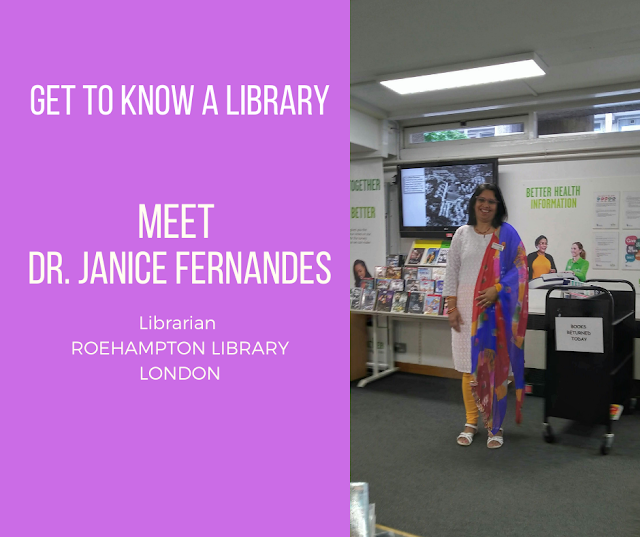
Get to Know a Library: Meet Dr. Janice Fernandes #2

Get to Know a Library

Roehampton Library is a public library nestled in the local communities and caters to a wide
and diverse range of customers from Putney , Roehampton and Barnes.
The library welcomes toddlers, little children , school and college goers , students from the
University of Roehampton, adults and older residents in the true spirit of equality and
diversity. We also welcome the physically and mentally challenged and strive to make their
visits comfortable, fruitful ad satisfactory.
Various events and activities carefully planned and implemented by Roehampton Library all
through the year both in the physical space as well as in the digital environment are focussed
on community participation, skill building, leisure and entertainment and knowledge growth
and sharing.
Below is a brief overview of the events and activities undertaken at Roehampton Library -
1. The need and importance of sing and reading to children and with children can never be
over emphasised. The correct tone, pronunciation, phonetics and intonation helps them
build a rich vocabulary and develop a love of reading. To this end the library has weekly
Rhyme Time and Story Time sessions. Additional assistance is provided through after
school Reading Support Club.
2. Saturday clubs, Colouring and craft activities and Dad’s story time attract a lot of
participants. Board games like chess, scrabble, word building etc provide intellectual
stimulus.
Innovating Libraries: Roehampton Library, London


3. Summer Reading Challenge is initiated every year at the beginning of the summer
holidays. Every attendee has to read 6 books and talk about them. Stickers, prizes and
medals are awarded.
4. Various schools and nurseries in the surrounding area bring children to the library for
Class visits, story telling, curriculum support and book selection. This is implemented
with the school literacy co-ordinator so that a properly structured timetable is in place.
5. Various after school club activities like Coding Club, Science Club, Homework Club
etc. are in place during term time.
6. The library successfully organises ESOL classes (English for Speakers of Other
Languages) The duration of the courses is generally 72-84 hours with examinations and
certification at the end. English conversation classes also take place on a weekly basis.
7. Two hour public computer use is offered to library members every day. To support this
I.T. training classes and held on general as well as specific topics for the adults and
older residents.
8. Book Clubs, Reading Groups, Poetry Groups and Knit and Natter Clubs are held
fortnightly. It gives the local community and opportunity to gather together, participate
and learn new ideas.
Innovating Libraries: Roehampton Library, London
9. Exhibitions, Workshops, Talks, Oral History projects, Good health and Well being
lectures are held on different occasions throughout the year.
10. The month of October is celebrated as Black History Month. Various artists, authors
and organizations visit the library though pre-planned projects, workshops and
interactive sessions.
11. Special events are organised for special days like Holocaust Memorial Day, Poppy Day,
Library Week, Term Breaks and Festival days.
12. The library offers its space, furniture, computers and resources to any organization or
individual who might want to run an event for the good of the community.
13. Local councillors and MPs use the library space to interact with residents every Saturday.

Dr. Janice Fernandes is a Librarian with Roehampton Library, London for the past three years. She has been proactive in Information Literacy sessions as she feels customer service is the core of any library. She is gifted with excellent communication and presentation skills. As such she is constantly upskilling herself and her library users with team building activities.


Note: All the photos included in this blog post have the copyright of Roehampton Library, London.

Cite as:
Bhange, C. (2021). Get to Know a Library: Roehampton Public Library [Blog]. Retrieved from https://chinmayeebhange.blogspot.com/2021/03/get-to-know-library-meet-dr-janice.html

Thursday, 18 February 2021

DSpace for academic libraries - Part 1


Chinmayee Bhange

DSpace is an Open Source Software package which is most commonly used by institutions to archive and make accessible scholarly content created or generated by the institute. The content may range from born digital items to scanned copies.

It was released in the November of 2002 by Duraspace. Currently, it has version 6.3 ready for download using GitHub. It uses JAVA for programming. For more details, please visit https://duraspace.org/dspace/


DSpace is a repository making software which is freely available for download and customization. It is used to collect and preserve the published articles, white papers, working papers, reports, data sets, edited books and such other scholarly content of the institute in one place.

The various sections or topics in DSpace are referred to as a Community. A Community has sub-communities. So, for example, a community can be the Department of Computer Science. The Sub- Community under this Community can be Books, Journal Articles, etc.

Essentially, a Community is the broad group which can be further categorised as per the need or ease of retrieval.

These Communities have e people and e groups who are the admin or super admin of the groups. Which means they have the right to upload data (content) and allow or dis-allow access to specific people or user groups. This is the Administrator – Control interface.

In SFIT LIRC, we have been DSpace for many years now. Based on the need and intended use, we have created the following communities in our DSpace@SFIT.

Creating Community:

        Each DSpace unit (or service) which we want to group together is comprised of Communities – the highest level of the Dspace content hierarchy

        Communities may be:

        Departments

        Labs   

        Research Centres

        Schools

        Each community contains descriptive metadata about itself and the collections contained within it

        Every community in turn have collections which contain items or files and contains Descriptive Metadata

Example from our LIRC at St.Francis Institute of Technology

Community

Sub-Community

Collection

Items

Approved Lists

Journals

UGC CARE

List 1


SCIMAGO Journal and Country Rankings

List 1


Example for any library to start with:

Community

Sub-Community

Collection

Items

Name of the Department

Publications

Books, Journals, Conference Proceedings

Soft Copies of Books, Journals, Conference Proceedings. Make sure you have the copyright to upload material!


Projects

Sponsored by Institute

Grants from GOI

Grants from AICTE

Working Papers, Models and Final Completion Certificates


1.     Sign in to DSPace using Administrator login

2.     Determine a name for your Top Level Community

3.     Go to “Communities and Collections”

4.     Click on “Create Community”

5.     Provide the required Metadata for your Community

6.     Set proper Authorization hierarchy or Access Rights

7.     Click on “Create”

8.     You can edit your Community and metadata at this stage too

9.     After editing, do not forget to click on “Update”

References:

https://www.ohiolink.edu/sites/default/files/uploads/CreateCommunities.pdf


An introduction to DSpace - ScholarSpace

scholarspace.manoa.hawaii.edu › bitstream › Module 3 .