Thursday, 30 November 2023
Happy Birthday to ChatGPT
Wednesday, 22 November 2023
Application of Google Bard in Libraries - Few Pointers
Google Bard, a large language model (LLM) from Google AI, can be used in various ways to enhance library services. Here are some potential applications:
Knowledge Management and Reference: Bard can provide comprehensive and informative answers to patrons' questions, even if they are open-ended, challenging, or strange. It can access and process vast amounts of information from the internet, including academic databases, encyclopedias, and news sources. This can help librarians better assist patrons with research and information seeking.
Personalized Recommendations: Bard can analyze user data and preferences to provide personalized recommendations for books, articles, movies, and other resources. This can help patrons discover new and relevant content that aligns with their interests.
Content Creation and Translation: Bard can generate creative content, such as poems, scripts, musical pieces, email, and letters. It can also translate languages, which can be particularly useful for libraries with multilingual patrons or diverse collections.
Virtual Assistant and Chatbot: Bard can be integrated into virtual assistant technology or chatbots to provide 24/7 library support. This can help patrons access information and services even when libraries are closed or staff are unavailable.
Interactive Learning and Education: Bard can be used to create interactive learning experiences, such as quizzes, simulations, and educational games. This can enhance library-based programs and activities, especially for children and teens.
Accessibility Support: Bard can transcribe audio and video content, making it accessible to patrons with disabilities. It can also provide real-time translations for patrons who are hearing or visually impaired.
Community Engagement and Outreach: Bard can be used to engage with library patrons on social media and other online platforms. It can respond to comments, answer questions, and share interesting content. This can help libraries build stronger relationships with their communities and promote their services.
Research Assistance and Data Analysis: Bard can help librarians analyze research data and identify trends. This can be used to improve library services, develop new programs, and allocate resources more effectively.
Content Curation and Summarization: Bard can curate and summarize information from various sources, making it easier for patrons to digest large amounts of text or data. This can be particularly helpful for research papers, legal documents, or technical reports.
Virtual Tours and 3D Modeling: Bard can generate virtual tours of libraries, archives, and museum collections. It can also create 3D models of historical artifacts or architectural features, offering patrons immersive experiences.
Saturday, 18 November 2023
Deep Fake Challenges for Libraries
Overall, deep fakes pose a number of challenges for libraries. Libraries need to be aware of these challenges and develop strategies for addressing them. By doing so, libraries can help to ensure that they continue to be trusted sources of information and that they protect the privacy and security of their users.
In addition to the challenges listed above, deep fakes can also have a negative impact on trust and credibility. When people are exposed to deep fakes, it can make them less likely to trust information that they see or hear. This can have a negative impact on libraries, as people may be less likely to use library resources if they are not sure that the information is reliable.
Libraries can address the challenges posed by deep fakes by developing a number of strategies. These strategies include:
- Educating users about deep fakes: Libraries can educate users about deep fakes by providing them with information about how to identify and avoid deep fakes. This information can be provided through workshops, online tutorials, and other resources.
- Developing policies and procedures for dealing with deep fakes: Libraries can develop policies and procedures for dealing with deep fakes. These policies may include procedures for reporting deep fakes, removing deep fakes from collections, and responding to requests from individuals who have been deepfaked.
- Collaborating with other organizations: Libraries can collaborate with other organizations, such as news organizations and social media companies, to develop strategies for addressing the challenges posed by deep fakes. This collaboration can help to raise awareness of the issue and to develop effective solutions.
By taking these steps, libraries can help to mitigate the negative impact of deep fakes and ensure that they continue to be trusted sources of information.
Friday, 17 November 2023
Over 3.5 Crore Pages From History Now Available At Click Of A Mouse
Arun Singhal, director general, NAI, told TOI that digitalising the archival content was aimed at making them accessible online across the globe for research work or personal interest. “The process of digitalisation of 70 lakh documents is under way and we hope to tackle the 30.5 crore pages in the next two years,” said Singhal, adding that downloading of the items will be chargeable though at a nominal fee.
Singhal said a tender has been floated for the remaining work, which is estimated to cost Rs 90 crore. The archives portal itself will be revamped for easier access. The search engine will be AI-based and will have premium features for researchers to facilitate exchange of documents with other researchers.
Among the rich collection of private papers at NAI are those of Mahatma Gandhi, Dadabhai Naoroji, M R Jayakar, Maulana Abul Kalam Azad, Gopal Krishna Gokhale and Minoo Masani. It also has the files of the Indian National Army and records acquired from Canada, Germany, Malaysia, Myanmar, United Kingdom, United States, France, Russia, etc.
“Private papers are donated either by a person or their family members, so we attach their names and call it a private archive. Public records come from various government departments,” explained Singhal. “Besides, we have inherited documents like Mughal dynasty records, including farmans of Noorjehan.” The oldest at the archives are the 6th century Buddhist texts called the Gilgit manuscripts.
The digitised collections include cartographic documents, like history, forest and revenue maps created by the Survey of India and other maps and atlases of Indian and foreign origins.
There also were ample papers related to Netaji Subhas Chandra Bose’s INA, also known as Azad Hind Fauj. The archived content comprises files, newspapers, registers , nominal rolls, photo albums, trial papers and many more important documents files which throw light on the history of the INA. These papers are among the most important and authentic primary sources of information for researchers.
An official said that the records and manuscripts form the basis of a country’s cultural heritage and in order to check the destruction of the collection of records stored in the archives, various conservation techniques and scientific methods were being employed to ensure preservation of these records.
Earlier, 1.5 crore pages were digitalised per year and it would have taken 20 years for the complete digitalisation. “But now we are digitalising 15 crore pages per year. However, the task is daunting as 15% of the items that we have on papers are so brittle that they cannot be scanned. We have to repair them and the process, besides being expensive, is time consuming,” said Singhal, adding that one repairer is able to handle 1,000 sheets, each with two sides, per month.
Friday, 10 November 2023
Easily generate bibliometric insights—without coding
Data Fetcher(opens in new tab/window) is the name for a free API(opens in new tab/window) query tool available for users associated with institutions that subscribe to Scopus and/or SciVal. An API, or “Application Programming Interface” is an intermediary software program that gives users the option to pull datasets from a given platform (like Scopus) in a custom format that’s not available through the main platform interface. This comes in handy if you want to analyze bibliometric information from a platform like Scopus but the dataset is too large, or you have a set of linked metadata you want to query from different platforms – combining Scopus and SciVal data, for example.
Thursday, 2 November 2023
Chatgpt for Everyone - Free Certification by GUVI
Key Takeaways:
- Identify the components of the ChatGPT architecture and understand how it functions.
- Understand the basics of natural language processing (NLP) and language modeling.
- Process and analyze text data using techniques like tokenization, part-of-speech tagging, and named entity recognition.
- Train ChatGPT on your own custom datasets and prompts.
- Generate human-like responses to a wide range of prompts using ChatGPT.
- Write code to interact with the ChatGPT API and integrate it into your own projects.
Friday, 20 October 2023
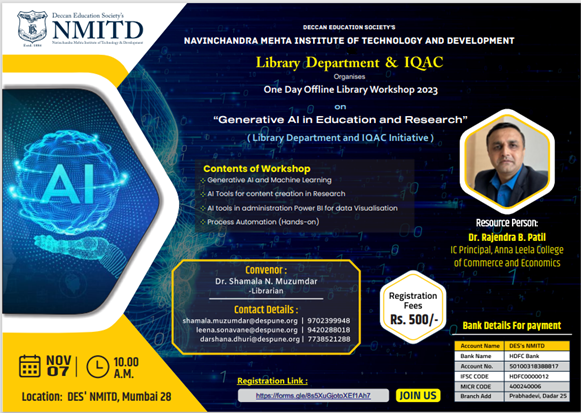
Workshop on " Generative AI in Education and Research " on 7th November 2023
♦️ Resource Persons: Dr. Rajendra B. Patil, IC Principal, Anna Leela College of Commerce and Economics
🗒 Date: Tuesday, 7th November, 2023
🕚 Time: 10.00 a.m. to 05:00 p.m.
🔺 Registration fee: Rs. 500/- (Inclusive All)
📯 Registration is Compulsory!
🔗 Registration link: https://forms.gle/8s5XuGjotoXEf1Ah7
🔺 Venue: DES’s Navinchandra Mehta Institute of Technology and Development, Dadar (W),
Mumbai 28.
🔺 Workshop includes high tea and Lunch.
Dr. Anita Bobade, In-Charge-Director, NMITD.
Dr. Rasika Mallya, Assoc. Director and IQAC Coordinator, NMITD.
Dr. Shamala Muzumdar, Convener and Librarian, NMITD.
Discussion on "Academic Integrity: The Way Forward with AI"
Turnitin, which has provided the world’s most adopted writing-to-learn products to more than 16000 institutions across 140 countries, would like to invite you to a discussion on "Academic Integrity: The Way Forward with AI", to commemorate the IDOA International Day of Action(18th October) for Academic Integrity.
- What is Academic Integrity & Original Writing?
- Define plagiarism, the plagiarism spectrum and understand the difference between plagiarism and text similarity
- Understand the guidelines around Academic Integrity by the Indian education governance bodies
- GPT and its impact
- Where are we headed given the latest concerns coming from generative AI?
- Role of Turnitin
Saturday, 14 October 2023
Workshop on Artificial Intelligence and Libraries: Implications and Applications" organized by Indira Gandhi Institute of Development and Research (IGIDR), Mumbai
I consider
myself very fortunate to have participated in today’s mesmerizing workshop!
The workshop on "Artificial
Intelligence and Libraries: Implications and Applications" organized by
Indira Gandhi Institute of Development and Research (IGIDR) gathered
professionals from the library and information science field to delve deep into
the world of Artificial Intelligence (AI) and explore its present landscape and
future applications in libraries. The event focused on generative AI tools such
as ChatGPT, Bing Chat, DALL-E, and Scopus AI, as well as AI-enabled research
tools. This report provides a summary of the key insights and discussions from
the workshop, emphasizing the potential of AI to transform library operations,
services, and knowledge management.
1. AI in Libraries: Landscape
and Future
The workshop began with an
overview of the current state of AI in libraries. Participants discussed the
rapid advancement of AI technologies and their relevance in libraries.
The future of AI in libraries
was explored, considering its implications for resource discovery, user
engagement, and data-driven decision-making.
2. Generative AI and Libraries by
ChatGPT/Google Bard:
Participants gained insights into the use of conversational AI for enhancing
user experiences, enabling quick responses to queries, and guiding users
through library resources.
Bing Chat: The potential of Bing
Chat in providing instant, AI-driven support to library users was highlighted,
along with its ability to enhance user media literacy.
Stable Diffusion/Bing Image
Generator (DALL-E): The workshop discussed how tools like DALL-E can revolutionize
content creation and visualization, making library operations more efficient
and user-centric.
3. Scopus AI: Change the Way You
View Knowledge
Participants explored how AI,
particularly in the context of Scopus AI, is poised to change the way knowledge
is indexed, searched, and accessed in library databases.
The workshop emphasized the
importance of libraries adapting to these changes and leveraging AI
technologies to enhance their services and support research activities.
4. AI-enabled Research Tools
The workshop provided an
opportunity to delve into AI-enabled research tools that have the potential to
revolutionize research endeavors in libraries.
Participants discussed the
skills needed to effectively utilize these tools, both for their own research
and for educating and empowering library users.
To conclude….
The "AI in Libraries"
workshop facilitated a deep dive into the evolving landscape of AI in
libraries. It highlighted the promising future of AI, focusing on generative AI
tools and AI-enabled research platforms. The event emphasized the importance of
adapting to these technologies to improve library operations, provide better
services, and support research activities effectively.
Participants left the workshop
with a greater understanding of how AI tools like ChatGPT, Bing Chat, DALL-E,
and Scopus AI can be harnessed to enhance their libraries. The knowledge and
skills acquired during the workshop will be instrumental in staying at the
forefront of library services and research support in the age of AI. Future
workshops and initiatives were proposed to ensure ongoing education and
collaboration in this dynamic field.
Thursday, 23 March 2023
Try BARD
Today we’re starting to open access to Bard, an early experiment that lets you collaborate with generative AI. This follows our announcements from last week as we continue to bring helpful AI experiences to people, businesses and communities.
You can use Bard to boost your productivity, accelerate your ideas and fuel your curiosity. You might ask Bard to give you tips to reach your goal of reading more books this year
Read the full article at: https://blog.google/technology/ai/try-bard/