Thursday, 30 November 2023
Happy Birthday to ChatGPT
Wednesday, 22 November 2023
Application of Google Bard in Libraries - Few Pointers
Google Bard, a large language model (LLM) from Google AI, can be used in various ways to enhance library services. Here are some potential applications:
Knowledge Management and Reference: Bard can provide comprehensive and informative answers to patrons' questions, even if they are open-ended, challenging, or strange. It can access and process vast amounts of information from the internet, including academic databases, encyclopedias, and news sources. This can help librarians better assist patrons with research and information seeking.
Personalized Recommendations: Bard can analyze user data and preferences to provide personalized recommendations for books, articles, movies, and other resources. This can help patrons discover new and relevant content that aligns with their interests.
Content Creation and Translation: Bard can generate creative content, such as poems, scripts, musical pieces, email, and letters. It can also translate languages, which can be particularly useful for libraries with multilingual patrons or diverse collections.
Virtual Assistant and Chatbot: Bard can be integrated into virtual assistant technology or chatbots to provide 24/7 library support. This can help patrons access information and services even when libraries are closed or staff are unavailable.
Interactive Learning and Education: Bard can be used to create interactive learning experiences, such as quizzes, simulations, and educational games. This can enhance library-based programs and activities, especially for children and teens.
Accessibility Support: Bard can transcribe audio and video content, making it accessible to patrons with disabilities. It can also provide real-time translations for patrons who are hearing or visually impaired.
Community Engagement and Outreach: Bard can be used to engage with library patrons on social media and other online platforms. It can respond to comments, answer questions, and share interesting content. This can help libraries build stronger relationships with their communities and promote their services.
Research Assistance and Data Analysis: Bard can help librarians analyze research data and identify trends. This can be used to improve library services, develop new programs, and allocate resources more effectively.
Content Curation and Summarization: Bard can curate and summarize information from various sources, making it easier for patrons to digest large amounts of text or data. This can be particularly helpful for research papers, legal documents, or technical reports.
Virtual Tours and 3D Modeling: Bard can generate virtual tours of libraries, archives, and museum collections. It can also create 3D models of historical artifacts or architectural features, offering patrons immersive experiences.
Sunday, 5 November 2023
Libraries and ChatGPT
Virtual Reference Services: Libraries can integrate ChatGPT into their websites or online catalogs to provide virtual reference services. Patrons can chat with ChatGPT to ask questions, seek information, and receive assistance with library resources.
Chatbots for FAQs:ChatGPT can be used to develop chatbots that answer frequently asked questions (FAQs). Patrons can interact with the chatbot to find information about library hours, policies, services, and more.
Information Retrieval:ChatGPT can assist patrons in searching for books, articles, and other resources in the library's catalog or databases. It can provide search tips and help users refine their queries.
Reading Recommendations:ChatGPT can offer personalized reading recommendations based on patrons' preferences, reading history, and interests. This can help users discover new books and authors.
Programming and Event Promotion:Libraries can use ChatGPT to promote upcoming events, workshops, and programs. Patrons can inquire about event details and registration through the chat interface.
Language Translation: ChatGPT can assist with language translation services, making library materials more accessible to a diverse community.
Accessibility Services: ChatGPT can provide information on the accessibility services available at the library, such as assistive technology, accessible formats, and accommodations for patrons with disabilities.
Library Policies and Procedures: ChatGPT can help patrons understand library policies, such as borrowing rules, interlibrary loans, and overdue fines. It can also guide users through various library procedures.
Information Literacy: Libraries can use ChatGPT to offer guidance on information literacy skills, including evaluating sources, citing references, and avoiding plagiarism.
Content Summaries: ChatGPT can provide brief summaries or abstracts of articles, research papers, or books, helping patrons decide whether a resource is relevant to their needs.
When implementing ChatGPT in a library setting, it's essential to ensure that the chatbot or virtual assistant is designed to complement human library staff and not replace them entirely. Human librarians can still provide valuable in-depth assistance and expertise that AI may not replicate. Additionally, privacy and data security considerations should be taken into account when using AI in libraries.
Thursday, 2 November 2023
Chatgpt for Everyone - Free Certification by GUVI
Key Takeaways:
- Identify the components of the ChatGPT architecture and understand how it functions.
- Understand the basics of natural language processing (NLP) and language modeling.
- Process and analyze text data using techniques like tokenization, part-of-speech tagging, and named entity recognition.
- Train ChatGPT on your own custom datasets and prompts.
- Generate human-like responses to a wide range of prompts using ChatGPT.
- Write code to interact with the ChatGPT API and integrate it into your own projects.
Friday, 20 October 2023
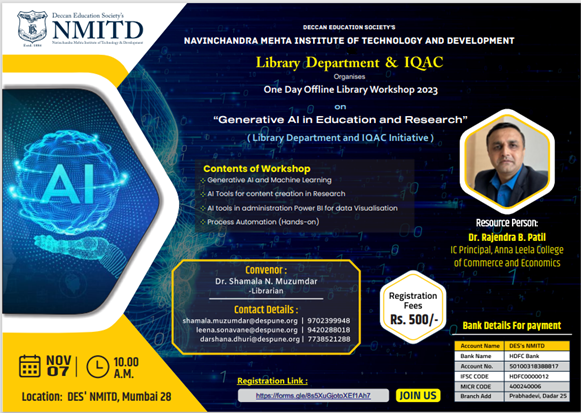
Workshop on " Generative AI in Education and Research " on 7th November 2023
♦️ Resource Persons: Dr. Rajendra B. Patil, IC Principal, Anna Leela College of Commerce and Economics
🗒 Date: Tuesday, 7th November, 2023
🕚 Time: 10.00 a.m. to 05:00 p.m.
🔺 Registration fee: Rs. 500/- (Inclusive All)
📯 Registration is Compulsory!
🔗 Registration link: https://forms.gle/8s5XuGjotoXEf1Ah7
🔺 Venue: DES’s Navinchandra Mehta Institute of Technology and Development, Dadar (W),
Mumbai 28.
🔺 Workshop includes high tea and Lunch.
Dr. Anita Bobade, In-Charge-Director, NMITD.
Dr. Rasika Mallya, Assoc. Director and IQAC Coordinator, NMITD.
Dr. Shamala Muzumdar, Convener and Librarian, NMITD.
Saturday, 14 October 2023
Workshop on Artificial Intelligence and Libraries: Implications and Applications" organized by Indira Gandhi Institute of Development and Research (IGIDR), Mumbai
I consider
myself very fortunate to have participated in today’s mesmerizing workshop!
The workshop on "Artificial
Intelligence and Libraries: Implications and Applications" organized by
Indira Gandhi Institute of Development and Research (IGIDR) gathered
professionals from the library and information science field to delve deep into
the world of Artificial Intelligence (AI) and explore its present landscape and
future applications in libraries. The event focused on generative AI tools such
as ChatGPT, Bing Chat, DALL-E, and Scopus AI, as well as AI-enabled research
tools. This report provides a summary of the key insights and discussions from
the workshop, emphasizing the potential of AI to transform library operations,
services, and knowledge management.
1. AI in Libraries: Landscape
and Future
The workshop began with an
overview of the current state of AI in libraries. Participants discussed the
rapid advancement of AI technologies and their relevance in libraries.
The future of AI in libraries
was explored, considering its implications for resource discovery, user
engagement, and data-driven decision-making.
2. Generative AI and Libraries by
ChatGPT/Google Bard:
Participants gained insights into the use of conversational AI for enhancing
user experiences, enabling quick responses to queries, and guiding users
through library resources.
Bing Chat: The potential of Bing
Chat in providing instant, AI-driven support to library users was highlighted,
along with its ability to enhance user media literacy.
Stable Diffusion/Bing Image
Generator (DALL-E): The workshop discussed how tools like DALL-E can revolutionize
content creation and visualization, making library operations more efficient
and user-centric.
3. Scopus AI: Change the Way You
View Knowledge
Participants explored how AI,
particularly in the context of Scopus AI, is poised to change the way knowledge
is indexed, searched, and accessed in library databases.
The workshop emphasized the
importance of libraries adapting to these changes and leveraging AI
technologies to enhance their services and support research activities.
4. AI-enabled Research Tools
The workshop provided an
opportunity to delve into AI-enabled research tools that have the potential to
revolutionize research endeavors in libraries.
Participants discussed the
skills needed to effectively utilize these tools, both for their own research
and for educating and empowering library users.
To conclude….
The "AI in Libraries"
workshop facilitated a deep dive into the evolving landscape of AI in
libraries. It highlighted the promising future of AI, focusing on generative AI
tools and AI-enabled research platforms. The event emphasized the importance of
adapting to these technologies to improve library operations, provide better
services, and support research activities effectively.
Participants left the workshop
with a greater understanding of how AI tools like ChatGPT, Bing Chat, DALL-E,
and Scopus AI can be harnessed to enhance their libraries. The knowledge and
skills acquired during the workshop will be instrumental in staying at the
forefront of library services and research support in the age of AI. Future
workshops and initiatives were proposed to ensure ongoing education and
collaboration in this dynamic field.
Thursday, 16 March 2023
ChatGPT and Fake Citations: Article from Duke University Libraries
Unless you’ve been living under a rock, you’ve heard the buzz about ChatGPT. It can write papers! Debug code! Do your laundry! Create websites from thin air! While it is an exciting tech development with enormous possibilities for applications, understanding what’s under the hood and what it does well/not-so-well is critically important.
ChatGPT is an Artificial Intelligence Chatbot developed by OpenAI and launched for public use in November 2022. While other AI chatbots are also in development by tech giants such as Google, Apple, and Microsoft, OpenAI’s early rollout has eclipsed the others for now – with the site reaching more than 100 million users in 2 months. For some perspective, this is faster widespread adoption than TikTok, Instagram, and many other popular apps.
What you may not know about ChatGPT is that it has significant limitations as a reliable research assistant. One such limitation is that it has been known to fabricate or “hallucinate” (in machine learning terms) citations. These citations may sound legitimate and scholarly, but they are not real.
Read the full article at: https://blogs.library.duke.edu/blog/2023/03/09/chatgpt-and-fake-citations/
Source: Duke University Library Blog