Showing posts with label Libraries. Show all posts

Thursday, 7 August 2025

Upcoming CFPs & Calls for Librarians and Information Professionals (2025)

If you’re looking to get involved in research, presentations, editing, or peer reviewing this year, here’s a curated list of exciting opportunities in the library, archives, and information science fields. These calls cover a wide range of topics—from AI ethics to institutional repositories, open access, and well-being in academia.

1. Ethical AI in GLAM — Collections Journal Focus Issue

Deadline: October 20, 2025
Format: Peer-reviewed journal articles
Focus: Ethical issues surrounding AI in Galleries, Libraries, Archives, and Museums (GLAM). Case studies and reflections on digital stewardship encouraged.
Details: Articles up to 5,000 words. Contact Angela Fritz (aifritz465@gmail.com) and Juilee Decker (jdgsh@rit.edu) for info.


2. Journal of Business and Finance Librarianship (JBFL) — Call for Reviewers

Deadline: Ongoing
Format: Peer reviewing manuscripts
Focus: Business and finance librarianship across academic, public, and corporate sectors.
Details: Interested reviewers can contact Estephan at estephan2@icloud.com.


3. 2025 Medical Institutional Repositories in Libraries (MIRL) Symposium

Date: November 20, 2025 (Virtual)
Deadline for Proposals: September 5, 2025
Format: Presentations (20 min) and lightning talks (10 min)
Focus: IR practices, policies, platform migration, open access, and innovations in medical and health sciences repositories.
Submit: MIRL CFP
Contact: Steven Moore (smoore31@hfhs.org)


4. LOEX Fall Focus 2025 Conference

Dates: November 17–19, 2025 (Virtual)
Deadline for Proposals: September 5, 2025
Format: 50-minute presentations and 7-minute lightning talks
Focus: Artificial Intelligence, Archives & Special Collections, Sense of Belonging in library instruction and information literacy.
Submit: LOEX Fall Focus CFP


5. Ticker: The Academic Business Librarianship Review — Call for Articles

Deadline for Summer Issue: October 10, 2025
Format: Peer-reviewed and editorial-reviewed articles
Focus: Research and case studies related to business librarianship, with encouragement for early-career authors.
Submit: Ticker Journal
Contact: Ash Faulkner (faulkner.172@osu.edu)


6. OA25 Open Access Conference — Defend Research, Defend Open Access

Date: October 21, 2025 (Virtual)
Deadline for Proposals: August 1, 2025
Format: 20- or 40-minute presentations
Focus: Addressing government censorship, open access preservation, labor issues, and global perspectives on open research environments.
Contact: Dawn Hackman (dawn.hackman@sjsu.edu)


7. Humanities Methods in Librarianship — Call for Editors

Deadline to Apply: September 15, 2025
Format: Editorial roles
Focus: Publishing peer-reviewed research that applies humanities methods to library science. Open to diverse academic backgrounds.
Apply: Via form linked in the CFP or email editors@humanitiesmethods.org for info.


8. FACRL 2025 Virtual Conference — Well-Being in Higher Education: The Library's Evolving Role

Date: October 24, 2025 (Virtual)
Deadline for Proposals: July 11, 2025 (rolling reviews begin May 19)
Format: 45-minute presentations, posters, lightning talks
Focus: Innovative programs, spaces, and strategies promoting mental health and wellness in academic libraries.
Contact: Leah Plocharczyk (lplochar@fau.edu)
More info: Potential publication opportunity in The Reference Librarian.

Whether you want to share your research, contribute to open access, support well-being initiatives, or dive into the ethics of AI in libraries, these calls offer many ways to get involved and make an impact. Mark your calendars and submit your proposals — your expertise and voice are needed!


Monday, 11 December 2023

SoFerence 2024 Transformation of Libraries: The Design Thinking Way Organised by Tata Consultancy Services, Bangalore 20 January 2024

The theme of SoFerence is “Transformation of Libraries: Design Thinking Way”.

IMPORTANT DATES

31st December 2023 | Last date for Registration 

2nd January 2024 | Registration Confirmation 

6th January 2024 | Online Pre-SoFerence 

20th January 2024 | SoFerence

AWARDS


For More Details: SoFerence 2024


Monday, 20 November 2023

SWAYAM course ‘Introduction to Intellectual Property’ for January 2024

Enrolment for the SWAYAM course ‘Introduction to Intellectual Property’ for January 2024 semester is open now. The course will start from 29 January 2024.

It is a 12-week course developed by best-in-field instructors and comprises of workshops, tutorials, weekly assignments, quizzes and mini-project. Learner may also take a proctored exam at the end of the course in case he/ she wishes to earn academic credits (3- Credits) for it.

Enrolment will be open till 28 February. Registration is Free. Interested learners may sign-up earliest to enrol for this course at https://onlinecourses.swayam2.ac.in/aic24_ge17/preview

Introductory video link: https://www.youtube.com/watch?v=HNSbZGeSwjs&t=13s

Who can register:

Students (pursuing/ completed graduation, post-graduation, 12th), Teachers, Faculty, Engineers, Researchers, Professors, Academic coordinators, Principal, Vice-Principals of Schools, Start-up Founders, Incubation Managers, PhD Scholars, IP professionals, lawyers and anyone who wants to understand Intellectual property and its real-life aspects.

Highlights of the course:

  1. Learn Basics of Patent, Trademark, Copyright, Industrial Design, and other IPRs
  2. Understand practical aspects through case studies on various IPRs
  3. Learn from the best-in-field experts
  4. Monitor your progress through weekly assignments
  5. Earn Academic Credits through Proctored Exam (optional)

Enclosed is a banner with a registration QR code. Please circulate it to your colleagues/ students, so that maximum number of learners get benefit from it.

For any technical support related to registration, completion certificate, etc., write at aicteswayam@aicte-india.org or call at 011 2958 1202

PFA: https://drive.google.com/file/d/1HzxMW40Ed6Te1yqOcdullTz5KS8aRI7t/view?usp=sharing 

Sunday, 19 November 2023

Librarian's Role in Copyright Protection

Librarians play a crucial role in copyright protection by educating users about copyright law, promoting fair use principles, and developing policies and procedures to ensure compliance with copyright regulations. Here's a detailed breakdown of their responsibilities:

  1. Educating Users about Copyright Law: Librarians raise awareness about copyright law and its implications for users. They provide clear explanations of copyright concepts, such as exclusive rights, ownership, and limitations, to help users understand the legal framework surrounding copyrighted works.

  2. Promoting Fair Use Principles: Librarians advocate for fair use, a legal doctrine that allows for limited use of copyrighted material without permission from the copyright holder. They explain the four Fair Use factors and help users determine when their use of copyrighted material falls within the boundaries of fair use.

  3. Developing Copyright Policies: Librarians establish clear copyright policies for their institutions, outlining guidelines for the use of copyrighted materials within the library's facilities and resources. These policies address issues such as copying, digitization, and distribution of copyrighted works.

  4. Enforcing Copyright Compliance: Librarians ensure that library staff and users adhere to copyright regulations. They monitor activities such as photocopying, scanning, and electronic distribution of copyrighted materials to prevent unauthorized use.

  5. Providing Copyright Guidance: Librarians offer guidance to patrons on copyright-related questions and concerns. They advise users on obtaining copyright permissions, navigating licensing agreements, and avoiding copyright infringement.

  6. Addressing Copyright Infringement: Librarians handle instances of copyright infringement within the library's domain. They may educate users about their infringement, remove infringing materials, or take appropriate disciplinary action.

  7. Collaborating with Copyright Holders: Librarians maintain positive relationships with copyright holders, such as publishers, authors, and producers. They engage in dialogue and negotiations to facilitate access to copyrighted materials while respecting intellectual property rights.

  8. Staying Informed about Copyright Developments: Librarians keep abreast of evolving copyright laws and court rulings to ensure that their policies and practices remain compliant. They attend workshops, conferences, and seminars to stay updated on copyright issues.

  9. Advocating for Balanced Copyright Laws: Librarians advocate for copyright laws that strike a balance between protecting intellectual property and enabling access to information and knowledge. They engage with policymakers to promote fair and equitable copyright frameworks.

  10. Promoting Open Access: Librarians support open access initiatives, which make scholarly and other research freely available to the public. They promote open access journals and repositories, and they educate users about the benefits of open access.

Through these efforts, librarians play a critical role in upholding copyright principles, ensuring responsible use of copyrighted materials, and promoting a balanced approach to intellectual property protection.

Saturday, 18 November 2023

Role of Librarians in promoting library services

Librarians play a crucial role in promoting library services and ensuring that users are aware of the vast array of resources available to them. They act as intermediaries between the library's collections and its patrons, helping users find the information they need and navigate the ever-changing landscape of information resources.

Here are some of the specific ways in which librarians promote library services:

  1. Developing and implementing marketing and outreach strategies: Librarians create and execute marketing campaigns to raise awareness of library services and attract new users. They may use a variety of channels to reach their target audience, such as social media, email marketing, and print and online advertising.

  2. Providing customer service and support: Librarians are the front line of customer service in libraries. They answer questions, provide assistance with research, and troubleshoot technical problems. They also offer guidance on how to use library resources effectively.

  3. Teaching information literacy skills: Librarians teach users how to find, evaluate, and use information effectively. They may offer workshops, classes, and online tutorials on a variety of topics, such as conducting research, using online databases, and avoiding plagiarism.

  4. Curating and promoting library collections: Librarians select and organize materials for the library's collections. They also promote these collections through displays, book clubs, and other events.

  5. Building relationships with the community: Librarians engage with the community by participating in local events, partnering with schools and businesses, and serving on community boards. They also work to make the library a welcoming and inclusive space for all.

  6. Advocating for library funding: Librarians advocate for library funding by speaking to elected officials, writing letters to the editor, and participating in public hearings. They also educate the public about the value of libraries.

  7. Keeping up with emerging technologies: Librarians stay up-to-date on the latest technologies and trends in order to provide users with the best possible service. They may experiment with new technologies and offer training to users on how to use them.

  8. Promoting open access: Librarians support open access initiatives, which make scholarly and other research freely available to the public. They may create and manage institutional repositories and advocate for open access policies.

  9. Copyright education: Librarians teach users about copyright law and how to use copyrighted materials legally. They also help users navigate the complex world of copyright permissions.

  10. Promoting digital literacy: Librarians teach users how to use digital tools effectively and safely. They may offer workshops on topics such as online privacy, social media etiquette, and cybersecurity.

By carrying out these activities, librarians play a vital role in promoting library services and ensuring that users have access to the information and resources they need to succeed in their academic, personal, and professional lives.

Deep Fake Challenges for Libraries


Overall, deep fakes pose a number of challenges for libraries. Libraries need to be aware of these challenges and develop strategies for addressing them. By doing so, libraries can help to ensure that they continue to be trusted sources of information and that they protect the privacy and security of their users.

In addition to the challenges listed above, deep fakes can also have a negative impact on trust and credibility. When people are exposed to deep fakes, it can make them less likely to trust information that they see or hear. This can have a negative impact on libraries, as people may be less likely to use library resources if they are not sure that the information is reliable.

Libraries can address the challenges posed by deep fakes by developing a number of strategies. These strategies include:

  • Educating users about deep fakes: Libraries can educate users about deep fakes by providing them with information about how to identify and avoid deep fakes. This information can be provided through workshops, online tutorials, and other resources.
  • Developing policies and procedures for dealing with deep fakes: Libraries can develop policies and procedures for dealing with deep fakes. These policies may include procedures for reporting deep fakes, removing deep fakes from collections, and responding to requests from individuals who have been deepfaked.
  • Collaborating with other organizations: Libraries can collaborate with other organizations, such as news organizations and social media companies, to develop strategies for addressing the challenges posed by deep fakes. This collaboration can help to raise awareness of the issue and to develop effective solutions.

By taking these steps, libraries can help to mitigate the negative impact of deep fakes and ensure that they continue to be trusted sources of information.

Friday, 17 November 2023

Over 3.5 Crore Pages From History Now Available At Click Of A Mouse

New Delhi: The National Archives of India, custodians of some of the country’s most valuable manuscripts and historical records, has digitalised over 3.5 crore pages, among them the private papers of the nation’s first president, Dr Rajendra Prasad, and Sardar Vallabhbhai Patel.
Arun Singhal, director general, NAI, told TOI that digitalising the archival content was aimed at making them accessible online across the globe for research work or personal interest. “The process of digitalisation of 70 lakh documents is under way and we hope to tackle the 30.5 crore pages in the next two years,” said Singhal, adding that downloading of the items will be chargeable though at a nominal fee.
Singhal said a tender has been floated for the remaining work, which is estimated to cost Rs 90 crore. The archives portal itself will be revamped for easier access. The search engine will be AI-based and will have premium features for researchers to facilitate exchange of documents with other researchers.
Among the rich collection of private papers at NAI are those of Mahatma Gandhi, Dadabhai Naoroji, M R Jayakar, Maulana Abul Kalam Azad, Gopal Krishna Gokhale and Minoo Masani. It also has the files of the Indian National Army and records acquired from Canada, Germany, Malaysia, Myanmar, United Kingdom, United States, France, Russia, etc.
“Private papers are donated either by a person or their family members, so we attach their names and call it a private archive. Public records come from various government departments,” explained Singhal. “Besides, we have inherited documents like Mughal dynasty records, including farmans of Noorjehan.” The oldest at the archives are the 6th century Buddhist texts called the Gilgit manuscripts.
The digitised collections include cartographic documents, like history, forest and revenue maps created by the Survey of India and other maps and atlases of Indian and foreign origins.
There also were ample papers related to Netaji Subhas Chandra Bose’s INA, also known as Azad Hind Fauj. The archived content comprises files, newspapers, registers , nominal rolls, photo albums, trial papers and many more important documents files which throw light on the history of the INA. These papers are among the most important and authentic primary sources of information for researchers.
An official said that the records and manuscripts form the basis of a country’s cultural heritage and in order to check the destruction of the collection of records stored in the archives, various conservation techniques and scientific methods were being employed to ensure preservation of these records.
Earlier, 1.5 crore pages were digitalised per year and it would have taken 20 years for the complete digitalisation. “But now we are digitalising 15 crore pages per year. However, the task is daunting as 15% of the items that we have on papers are so brittle that they cannot be scanned. We have to repair them and the process, besides being expensive, is time consuming,” said Singhal, adding that one repairer is able to handle 1,000 sheets, each with two sides, per month.
The NAI DG said there were currently 50 repairers. “They repair six lakh sheets per year. We will need around 1,000 people to repair the damaged records in the next two years and require 500 workers per shift to digitalise the same,” said Singhal.

Sunday, 5 November 2023

Libraries and ChatGPT

Libraries and ChatGPT can be connected in several ways to enhance library services and engage with library patrons. Here are some ways in which libraries can leverage ChatGPT:

Virtual Reference Services: Libraries can integrate ChatGPT into their websites or online catalogs to provide virtual reference services. Patrons can chat with ChatGPT to ask questions, seek information, and receive assistance with library resources.

Chatbots for FAQs:ChatGPT can be used to develop chatbots that answer frequently asked questions (FAQs). Patrons can interact with the chatbot to find information about library hours, policies, services, and more.

Information Retrieval:ChatGPT can assist patrons in searching for books, articles, and other resources in the library's catalog or databases. It can provide search tips and help users refine their queries.

Reading Recommendations:ChatGPT can offer personalized reading recommendations based on patrons' preferences, reading history, and interests. This can help users discover new books and authors.

Programming and Event Promotion:Libraries can use ChatGPT to promote upcoming events, workshops, and programs. Patrons can inquire about event details and registration through the chat interface.

Language Translation: ChatGPT can assist with language translation services, making library materials more accessible to a diverse community.

Accessibility Services: ChatGPT can provide information on the accessibility services available at the library, such as assistive technology, accessible formats, and accommodations for patrons with disabilities.

Library Policies and Procedures: ChatGPT can help patrons understand library policies, such as borrowing rules, interlibrary loans, and overdue fines. It can also guide users through various library procedures.

Information Literacy: Libraries can use ChatGPT to offer guidance on information literacy skills, including evaluating sources, citing references, and avoiding plagiarism.

Content Summaries: ChatGPT can provide brief summaries or abstracts of articles, research papers, or books, helping patrons decide whether a resource is relevant to their needs.

Interactive Tutorials: Libraries can create interactive tutorials and guides using ChatGPT to help patrons learn how to use library resources effectively.

Remote Assistance: ChatGPT can provide assistance to patrons who are accessing library services remotely, such as e-book downloads, database access, and research support.

When implementing ChatGPT in a library setting, it's essential to ensure that the chatbot or virtual assistant is designed to complement human library staff and not replace them entirely. Human librarians can still provide valuable in-depth assistance and expertise that AI may not replicate. Additionally, privacy and data security considerations should be taken into account when using AI in libraries.

Saturday, 4 November 2023

How Can You Update Your Library Skills?

Updating your library skills is essential to stay relevant in the field and provide valuable services to library patrons. Here are some steps you can take to update your library skills:

Continuing Education: Attend library conferences and workshops: Participating in conferences and workshops can provide you with the latest trends, technologies, and best practices in the library field.
Take online courses: Many organizations and institutions offer online courses on various library-related topics, from information literacy to collection management.

Networking: Join library associations which help you connect with colleagues and access resources for professional development.

Professional Journals and Publications: Read professional literature: Keep up with current library trends and research by regularly reading library-related journals, magazines, and academic publications.

Technology Skills: Stay current with library technology: Libraries often use various software and tools. Ensure you have up-to-date knowledge of library management systems, databases, and digital platforms.
Learn about emerging technologies: Explore technologies like artificial intelligence, virtual reality, and blockchain that can impact library services and resources.

Webinars and Online Resources: Attend webinars: Many library organizations offer webinars on specific topics. These can be a convenient way to learn from experts in the field.
Utilize online resources: Access online resources, such as webinars, podcasts, and blogs, to keep up with emerging trends and best practices in libraries.

Specialized Skills: Develop specialized skills: Depending on your role in the library, you may need to acquire specific skills, such as metadata management, digital preservation, or data analytics.

Collaborate with Colleagues: Work with colleagues on projects: Collaborative projects with colleagues can provide valuable learning experiences and insights into different areas of library work.

Library Management and Leadership: Explore management and leadership training: If you aspire to leadership roles in the library, consider courses or resources that focus on management, leadership, and strategic planning.

Evaluate and Reflect: Reflect on your current skills and areas where improvement is needed. Regular self-assessment can help you identify areas for growth.

Mentoring: Seek mentorship: Connecting with an experienced librarian who can guide and advise you on professional development can be highly beneficial.

Remember that library skills encompass a broad range of areas, so it's important to tailor your skill development to your specific role and goals within the library profession. Continual learning and adaptation are key to staying relevant in this dynamic field.

Thursday, 16 March 2023

ChatGPT and Fake Citations: Article from Duke University Libraries

Unless you’ve been living under a rock, you’ve heard the buzz about ChatGPT. It can write papers! Debug code! Do your laundry! Create websites from thin air! While it is an exciting tech development with enormous possibilities for applications, understanding what’s under the hood and what it does well/not-so-well is critically important. 

ChatGPT is an Artificial Intelligence Chatbot developed by OpenAI and launched for public use in November 2022. While other AI chatbots are also in development by tech giants such as Google, Apple, and Microsoft, OpenAI’s early rollout has eclipsed the others for now – with the site reaching more than 100 million users in 2 months. For some perspective, this is faster widespread adoption than TikTok, Instagram, and many other popular apps.

What you may not know about ChatGPT is that it has significant limitations as a reliable research assistant.  One such limitation is that it has been known to fabricate or “hallucinate” (in machine learning terms) citations. These citations may sound legitimate and scholarly, but they are not real. 

Read the full article at: https://blogs.library.duke.edu/blog/2023/03/09/chatgpt-and-fake-citations/

Source: Duke University Library Blog

Wednesday, 10 February 2021

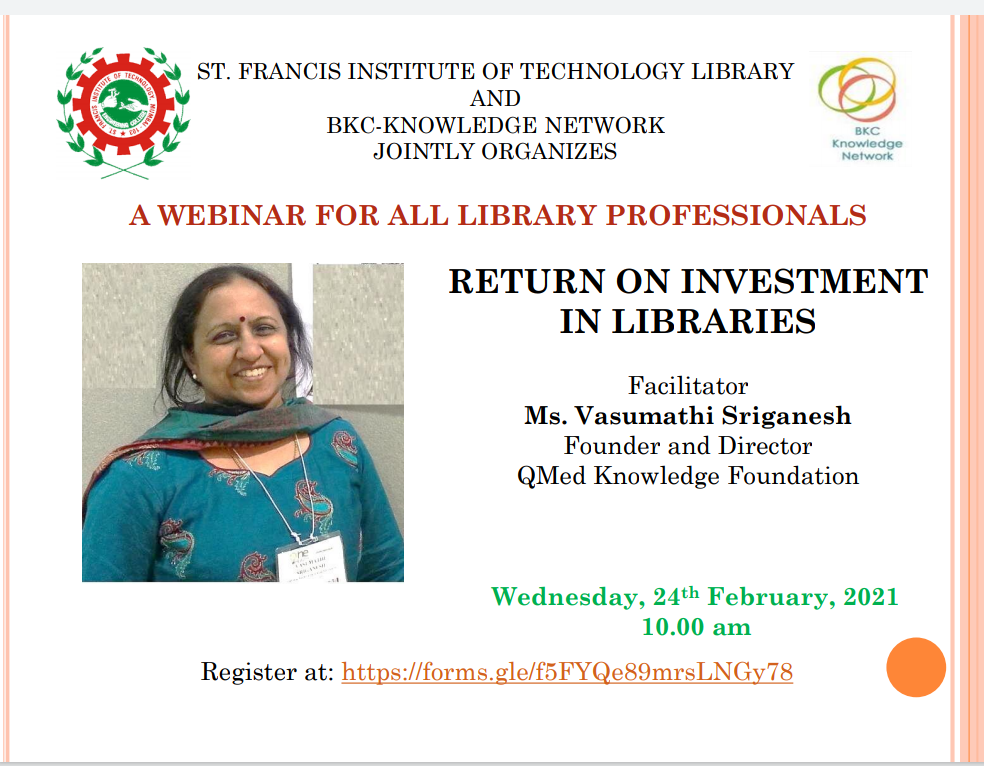
Webinar on Return on Investment in Libraries


People generally prefer to live nearby public libraries. Not because they would have access to enough books and Information alone. Libraries are a culture in themselves. They are a witness to history and are ever evolving places. Generations have passed but libraries will still carry a legacy. It's a proven fact that libraries are important for mental wellness. But do we the worth of these libraries? Every penny should count. We invest a heavy amount in books, journals and databases. But do we make forced choices, informed choices or sound choices? We understand return on investment in libraries in terms of usage such as number of books issued, number of footfalls and number of articles downloaded.
There is much more to it. What is it? How do we calculate? How to know the worth of my library?
Exactly all these questions will be answered by our Resource Person - Vasumathi Sriganesh.
Do join us for an interactive  webinar on 24th February, 2021 at 10 am.
Please find attached herewith the poster and the Registration link.