Showing posts with label librarians. Show all posts

Monday, 20 November 2023

SWAYAM course ‘Introduction to Intellectual Property’ for January 2024

Enrolment for the SWAYAM course ‘Introduction to Intellectual Property’ for January 2024 semester is open now. The course will start from 29 January 2024.

It is a 12-week course developed by best-in-field instructors and comprises of workshops, tutorials, weekly assignments, quizzes and mini-project. Learner may also take a proctored exam at the end of the course in case he/ she wishes to earn academic credits (3- Credits) for it.

Enrolment will be open till 28 February. Registration is Free. Interested learners may sign-up earliest to enrol for this course at https://onlinecourses.swayam2.ac.in/aic24_ge17/preview

Introductory video link: https://www.youtube.com/watch?v=HNSbZGeSwjs&t=13s

Who can register:

Students (pursuing/ completed graduation, post-graduation, 12th), Teachers, Faculty, Engineers, Researchers, Professors, Academic coordinators, Principal, Vice-Principals of Schools, Start-up Founders, Incubation Managers, PhD Scholars, IP professionals, lawyers and anyone who wants to understand Intellectual property and its real-life aspects.

Highlights of the course:

  1. Learn Basics of Patent, Trademark, Copyright, Industrial Design, and other IPRs
  2. Understand practical aspects through case studies on various IPRs
  3. Learn from the best-in-field experts
  4. Monitor your progress through weekly assignments
  5. Earn Academic Credits through Proctored Exam (optional)

Enclosed is a banner with a registration QR code. Please circulate it to your colleagues/ students, so that maximum number of learners get benefit from it.

For any technical support related to registration, completion certificate, etc., write at aicteswayam@aicte-india.org or call at 011 2958 1202

PFA: https://drive.google.com/file/d/1HzxMW40Ed6Te1yqOcdullTz5KS8aRI7t/view?usp=sharing 

Saturday, 18 November 2023

Deep Fake Challenges for Libraries


Overall, deep fakes pose a number of challenges for libraries. Libraries need to be aware of these challenges and develop strategies for addressing them. By doing so, libraries can help to ensure that they continue to be trusted sources of information and that they protect the privacy and security of their users.

In addition to the challenges listed above, deep fakes can also have a negative impact on trust and credibility. When people are exposed to deep fakes, it can make them less likely to trust information that they see or hear. This can have a negative impact on libraries, as people may be less likely to use library resources if they are not sure that the information is reliable.

Libraries can address the challenges posed by deep fakes by developing a number of strategies. These strategies include:

  • Educating users about deep fakes: Libraries can educate users about deep fakes by providing them with information about how to identify and avoid deep fakes. This information can be provided through workshops, online tutorials, and other resources.
  • Developing policies and procedures for dealing with deep fakes: Libraries can develop policies and procedures for dealing with deep fakes. These policies may include procedures for reporting deep fakes, removing deep fakes from collections, and responding to requests from individuals who have been deepfaked.
  • Collaborating with other organizations: Libraries can collaborate with other organizations, such as news organizations and social media companies, to develop strategies for addressing the challenges posed by deep fakes. This collaboration can help to raise awareness of the issue and to develop effective solutions.

By taking these steps, libraries can help to mitigate the negative impact of deep fakes and ensure that they continue to be trusted sources of information.

Saturday, 4 November 2023

How Can You Update Your Library Skills?

Updating your library skills is essential to stay relevant in the field and provide valuable services to library patrons. Here are some steps you can take to update your library skills:

Continuing Education: Attend library conferences and workshops: Participating in conferences and workshops can provide you with the latest trends, technologies, and best practices in the library field.
Take online courses: Many organizations and institutions offer online courses on various library-related topics, from information literacy to collection management.

Networking: Join library associations which help you connect with colleagues and access resources for professional development.

Professional Journals and Publications: Read professional literature: Keep up with current library trends and research by regularly reading library-related journals, magazines, and academic publications.

Technology Skills: Stay current with library technology: Libraries often use various software and tools. Ensure you have up-to-date knowledge of library management systems, databases, and digital platforms.
Learn about emerging technologies: Explore technologies like artificial intelligence, virtual reality, and blockchain that can impact library services and resources.

Webinars and Online Resources: Attend webinars: Many library organizations offer webinars on specific topics. These can be a convenient way to learn from experts in the field.
Utilize online resources: Access online resources, such as webinars, podcasts, and blogs, to keep up with emerging trends and best practices in libraries.

Specialized Skills: Develop specialized skills: Depending on your role in the library, you may need to acquire specific skills, such as metadata management, digital preservation, or data analytics.

Collaborate with Colleagues: Work with colleagues on projects: Collaborative projects with colleagues can provide valuable learning experiences and insights into different areas of library work.

Library Management and Leadership: Explore management and leadership training: If you aspire to leadership roles in the library, consider courses or resources that focus on management, leadership, and strategic planning.

Evaluate and Reflect: Reflect on your current skills and areas where improvement is needed. Regular self-assessment can help you identify areas for growth.

Mentoring: Seek mentorship: Connecting with an experienced librarian who can guide and advise you on professional development can be highly beneficial.

Remember that library skills encompass a broad range of areas, so it's important to tailor your skill development to your specific role and goals within the library profession. Continual learning and adaptation are key to staying relevant in this dynamic field.

Saturday, 21 October 2023

I-KOAL 2024 on 'Innovative Technologies and Applications for Sustainable Library Services' on February 15-16, 2024 at MITWPU, Pune


Source: Librarian of MITWPU, Pune

Library  Professionals Association (LPA) is organising I-KOAL 2024 on 'Innovative Technologies and Applications for Sustainable Library Services' on February 15-16, 2024 at MITWPU, Pune.

Theme: Innovative Technology and Applications for Sustainable Library Services

Sub-Theme: 
  • Knowledge Management
  • Research Data Management
  • Management of Digital Libraries 
  • Multimedia Content Management
  • Capacity Building & HR Management in Library Services
  • Sustainable Digital Library Model
  • Green Libraries: Concept & Processes
  • Public Library as Information & Cultural Hubs
  • Library Outreach, Marketing, and Advocacy in Digital Age
  • Modern Librarianship and Ethics
  • Emerging & Innovative Technology Applications in Libraries
  • Research Tools, Techniques and Methodologies
  • Open-Source Software application in Libraries
  • Smart use of Plagiarism Tools, IPR and Copyright in the Digital Age
  • Digital Library Consortia: Challenges and Future
  • Perspectives Role of Librarians and Libraries in Institutional Rankings
Important Dates:
December 31st, 2023 : Complete Paper Submission
January 10th, 2024 : Notification of Acceptance
January 15th, 2024 : Registration for Paper Submission

Friday, 20 October 2023

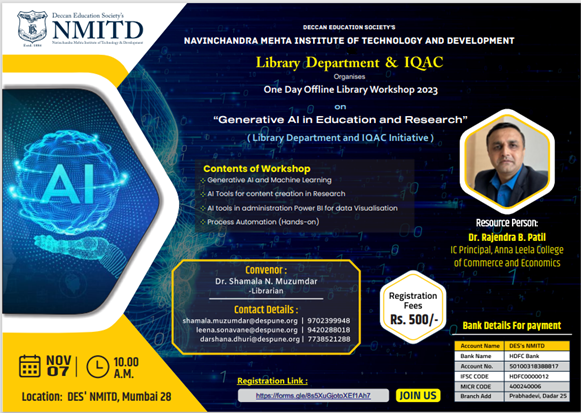
Workshop on " Generative AI in Education and Research " on 7th November 2023


The Library Department and IQAC of Deccan Education Society's Navinchandra Mehta Institute of Technology, Mumbai is pleased to announce a One Day offline Library Workshop on " Generative AI in Education and Research ".

 ♦️  Resource Persons: Dr. Rajendra B. Patil, IC Principal, Anna Leela College of Commerce and Economics

🗒  Date: Tuesday, 7th November, 2023

🕚  Time: 10.00 a.m. to 05:00 p.m.

🔺  Registration fee: Rs. 500/- (Inclusive All)

📯  Registration is Compulsory!

🔗  Registration link:  https://forms.gle/8s5XuGjotoXEf1Ah7 

🔺   Venue: DES’s Navinchandra Mehta Institute of Technology and Development, Dadar (W),  

        Mumbai 28.

🔺  Workshop includes high tea and Lunch.

Dr. Anita Bobade, In-Charge-Director, NMITD.

Dr. Rasika Mallya, Assoc. Director and IQAC Coordinator, NMITD.

Dr. Shamala Muzumdar, Convener and Librarian, NMITD.

Saturday, 14 October 2023

Workshop on Artificial Intelligence and Libraries: Implications and Applications" organized by Indira Gandhi Institute of Development and Research (IGIDR), Mumbai


(Photo Courtesy: IGIDR)

I consider myself very fortunate to have participated in today’s mesmerizing workshop!

The workshop on "Artificial Intelligence and Libraries: Implications and Applications" organized by Indira Gandhi Institute of Development and Research (IGIDR) gathered professionals from the library and information science field to delve deep into the world of Artificial Intelligence (AI) and explore its present landscape and future applications in libraries. The event focused on generative AI tools such as ChatGPT, Bing Chat, DALL-E, and Scopus AI, as well as AI-enabled research tools. This report provides a summary of the key insights and discussions from the workshop, emphasizing the potential of AI to transform library operations, services, and knowledge management.

1. AI in Libraries: Landscape and Future

The workshop began with an overview of the current state of AI in libraries. Participants discussed the rapid advancement of AI technologies and their relevance in libraries.

The future of AI in libraries was explored, considering its implications for resource discovery, user engagement, and data-driven decision-making.

2. Generative AI and Libraries by 

ChatGPT/Google Bard: Participants gained insights into the use of conversational AI for enhancing user experiences, enabling quick responses to queries, and guiding users through library resources.

Bing Chat: The potential of Bing Chat in providing instant, AI-driven support to library users was highlighted, along with its ability to enhance user media literacy.

Stable Diffusion/Bing Image Generator (DALL-E): The workshop discussed how tools like DALL-E can revolutionize content creation and visualization, making library operations more efficient and user-centric.

3. Scopus AI: Change the Way You View Knowledge

Participants explored how AI, particularly in the context of Scopus AI, is poised to change the way knowledge is indexed, searched, and accessed in library databases.

The workshop emphasized the importance of libraries adapting to these changes and leveraging AI technologies to enhance their services and support research activities.

4. AI-enabled Research Tools

The workshop provided an opportunity to delve into AI-enabled research tools that have the potential to revolutionize research endeavors in libraries.

Participants discussed the skills needed to effectively utilize these tools, both for their own research and for educating and empowering library users.

To conclude….

The "AI in Libraries" workshop facilitated a deep dive into the evolving landscape of AI in libraries. It highlighted the promising future of AI, focusing on generative AI tools and AI-enabled research platforms. The event emphasized the importance of adapting to these technologies to improve library operations, provide better services, and support research activities effectively.

Participants left the workshop with a greater understanding of how AI tools like ChatGPT, Bing Chat, DALL-E, and Scopus AI can be harnessed to enhance their libraries. The knowledge and skills acquired during the workshop will be instrumental in staying at the forefront of library services and research support in the age of AI. Future workshops and initiatives were proposed to ensure ongoing education and collaboration in this dynamic field.


Monday, 15 February 2021

RDMLA Course for librarians from Elsevier


The RDMLA consists of eight self-paced, asynchronous units that focus on the knowledge and skills needed to collaborate with researchers and other stakeholders on data management. The content has been thoughtfully designed to be practical and easily applied to a librarian’s daily data management workflow.

The eight units include:

  • Foundations of Research Data Management (RDM)
  • Navigating Research Culture
  • Advocating for RDM in Libraries
  • Launching Data Services
  • Project Management and Assessment
  • Data Analysis and Visualization Tools (R and Tableau)
  • Overview of Coding Tools (Python and Jupyter Notebooks)
  • Overview of Platform Tools (OSF, Figshare, Mendeley Data, and others

For more details, please visit:

https://www.elsevier.com/connect/library-connect/rdmla-free-training-course-for-librarians-now-offers-the-opportunity-to-earn-ce-credits

Friday, 12 February 2021

You're an Awesome Librarian! But Does the World Know It?

Part 3: Learn and Re-Learn


Being in the Library profession for over 16 years now, I have learnt a lot many things not only as a Librarian but as an individual. There are no yardsticks for any interaction per se in the libraries. As all of us would believe, libraries are places where people come to interact with books and other people. And exactly those 'other people' can be their friends, seniors, juniors, faculties, non-teaching staff and ofcourse 'WE the library staff'. Given the notion that a Librarian has to keep himself / herself occupied in a cabin and just supervise the staff has to be kept out of focus for the time-being. Imagine yourself having over 1000 friends and connections on FB and LinkedIn respectively but not more than ten souls recognize you in your campus. Bad isn't it?
Shed that inhibition, go out and talk with staff, faculties and students. People are comfortable when we interact and not only supervise. And mind you this 'Soft Skills Training' has to be on the job! There are no particular skill sets to be developed.
I remember being part of a newspaper collection drive in our college and the student group was creating superb paper made bags sitting in the Reading Room. I just could not resist myself from learning. That bunch of young kids were so happy to teach me and I too made a paper bag. Some time later, these students taught us to solve a Rubik's Cube (which I am yet to learn to a 'T').
On other days, students leave their circuit boards in the library because they are sure that our library is a safe place to store their belongings. There have been so many instances where students still keep their mobile phones with us before going to the examination hall. Its just that they believe in us a bit more than anything else.
I am sure any of my students reading this would definitely agree to this fact.
These are petty instances but they have been with me and have nurtured my belief as an individual.
Some essential learning to be done before taking that dive into the ocean...
The first one which I would recommend to each one is - Learn to write and maintain a blog. Use any platform - Blogger or Wordpress. But all libraries must have their own blog. Its the first social media module. The beauty of any blog is that we do not have to learn coding. Its all in-built. You just select a theme for your blog, name it, add sufficient content relevant to your institute library and publish it. Simple, isn't it?
The second is since practically all of us are on the FB, then why not our Library. Get that FB page carved and publicize it.
Get these two things moving if you are still doing "Work from Home" or have some time off in the library. I am sure you will bless me once you see people following your FB page. Be where your users are. Belong to their community (generation). Social Media is a boon after all!
With these two up and running, learn (all by yourself) or with the help of your IT person how to set up DSpace. I am thankful to our IT persons - Mr. Sachin Sawant and Mr. Johnson Pen for the extreme help and guidance for our Institute Repository hosted on DSpace.
All those who are familiar with the AICTE Approval Process Handbook for Engineering Colleges, I am sure an "Institute Repository" is essential.

Now coming to the actual training courses which will show up in your LinkedIn profile and add pages to your personal file.

1) RDMLA Course by Elsevier
2) Copyright for Librarians and Educators by Coursera
3) Research Data Management by Coursera
4) ALCTS Online Course Grant offered by ALA
5) Any Archival Management Course

Cite as:
Bhange, C. (2021). Learn and Re-Learn [Blog]. Retrieved from https://www.blogger.com/blog/post/edit/8545264270197918391/619779207828748416

Friday, 5 February 2021

You're an awesome Librarian! But does the world know it?

 Part Two: Move Around

You're an awesome Librarian! But does the World know it?

Designing or re-arranging library spaces calls for an understanding of the students' varying needs and demands - both individually and as a group.
We generally arrange books class number wise as per the Dewey Decimal Classification. Well, I am not asking anyone to change this! But there may be a few changes here and there, might add that extra flavour to our library.
Re-arranging furniture is a good idea but not always feasible. Colouring the library with vibrant and extravagant colours is another option, although it will bite into our budget.
Here are some of the things that we have been doing in our library:
  • Re-arrange existing tables periodically, thanks to our huge space. Amusing as it may seem, but we display all our red colour books in our show-cases in the month of February (Valentine's Day = Love for Books)
  • Faculty publications such as books are sometimes arranged on the Display Rack and at other times on a table which says - " I bet you know them".
  • Many of you would know that B.E. students (Final Year of Engineering) need to submit a project report as part of their degree course. we request respective departments to share with us the "Top Three Best Projects" every year. We then compile these with abstracts and keep them on the table saying "Best Project Reports" with the group photo of the students, if possible. Students actually flock to see their seniors projects.
  • If library wall space is limited, then convert the back side of that periodical rack into a lovely wall journal. May be you can utilize this space for:
  • 1) Feedback about library
  • 2) Novel Idea for library
  • 3) A Quote (Quotations) Wall
Nowadays, people live a very busy life. We do not have time to read the book reviews available on Amazon or GoodReads. We go by the number of star ratings. Taking this forward, the story book shelf (novels and classics) which are mostly read can be grouped together on a centre table in the library and displayed with a 5-star rating. If you are a creative nerd, you can have short one-liners from these books embedded into bubbles or cut-outs which can be easily pinned to the books using cloth-pins.

With libraries becoming a hub of all activities, there are few more ways to redesign our libraries. Some of them are:
  • Coloured Zones incorporated with IT facilities
  • Makerspaces having 3D printing facilities
  • Interview Cubicles: These may be considered as very useful for students who have to appear for online interviews as part of their recruitments but do not have the added advantage of high bandwidth.
  • Research Space: An area recognized specially for research scholars which includes a Desktop / Laptop space, charging points, baggage area etc....can be likened to a personal space in the library.
  • Idea Space: An area to discuss the feasibility of a project in a group, basically for brainstorming.
Cite as: 
Bhange, C., 2021. 
You're An Awesome Librarian! But Does The World Know It?. [online] Innovating Libraries. Available at: <https://chinmayeebhange.blogspot.com/2021/01/youre-awesome-librarian-but-does-world.html> 


Wednesday, 27 January 2021

You're an awesome Librarian! But does the world know it?

 PART 1: SOME TYPICAL INSTANCES AND WAYS TO RE-CONNECT


No.

INSTANCES YOU MIGHT RELATE TO

WAYS TO RE-CONNECT

1

Manual User Register at Entry Points

Jump start to Online!

a)   Connect with the ERP of your Institute

b)  Simplest way is to ask all users to enter their Roll No. in excel and maintain a date-wise sheet.

c)    Alternatively, install biometric machines.

2

Two Library cards for two books

Do not restrict to only two books!

We have so many books in the library. And even if we do not have sufficient number of study books, no worries. Re-shelve all your story books and biographies. Let the users have the feeling and trust that they can derive maximum benefit from the library.

3

Extra books to Toppers

It’s a common rule everywhere that toppers are given extra books as a token of appreciation. I feel, the students who have not been able to make it to success are in actual need of books to study harder. Why deprive them of their library? Work it out with your management and library committee. I am sure students will bless us with all their heart.

4

No Library Card = No books

ID card = Library books

If you have a bar-coded ID card, do away with library cards.

5

Periodicals cannot be issued

Display magazines with trendy topics at the counter. Let students flip through them.

Dedicate one day in a week, preferably Friday, to issue Periodicals.

6

Donations of old books not allowed

Accept book donations with a smiling face. We segregate these books as under:

a)   Rare books

b)  Children and Young Fiction

c)    Little Free Library

d)  Reading Inspiration Day Event

Our library members are actually waiting for the event of “Take Away of Books” on Reading Inspiration Day. And this has become a habit!

7

Library does not know about students’ projects

Magazines such as Electronics For You, Open Source For You have many Do-It-Yourself sections. Compile the projects and make a list. Share it in Google Classroom of your Library and on the blog.

8

No one comes to the library to read periodicals

a)   Now this is something where you need to invest your time and expertise.

b)  Select a few periodicals which have trending topics or ask faculties to suggest a few topics.

c)    Make a gist of two articles from these selected periodicals.

d)  Give a nice catchy title to your service and introduce it your users.

Let your users have two mails from the library every week.

9

Library Orientation

Re-design and Rename the traditional library orientation to “Information Literacy Hour”.

Take the freshers around the library in small batches and tell them what they would like to know most – books and internet access. To start with, show them story books section as most new students are not aware of their syllabus content.

10

Writing Quotes on Whiteboard

This is gateway to the library! So try playing with different options such as:

a)   Today In History

b)  Today in Science

c)    Today is National ----- Day

You may get to know more about this from Google Doodle which is dedicated to each day.


Cite as: 
Bhange, C., 2021. 
You're An Awesome Librarian! But Does The World Know It?. [online] Innovating Libraries. Available at: <https://chinmayeebhange.blogspot.com/2021/01/youre-awesome-librarian-but-does-world.html>