Thursday, 18 February 2021

DSpace for academic libraries - Part 1


Chinmayee Bhange

DSpace is an Open Source Software package which is most commonly used by institutions to archive and make accessible scholarly content created or generated by the institute. The content may range from born digital items to scanned copies.

It was released in the November of 2002 by Duraspace. Currently, it has version 6.3 ready for download using GitHub. It uses JAVA for programming. For more details, please visit https://duraspace.org/dspace/


DSpace is a repository making software which is freely available for download and customization. It is used to collect and preserve the published articles, white papers, working papers, reports, data sets, edited books and such other scholarly content of the institute in one place.

The various sections or topics in DSpace are referred to as a Community. A Community has sub-communities. So, for example, a community can be the Department of Computer Science. The Sub- Community under this Community can be Books, Journal Articles, etc.

Essentially, a Community is the broad group which can be further categorised as per the need or ease of retrieval.

These Communities have e people and e groups who are the admin or super admin of the groups. Which means they have the right to upload data (content) and allow or dis-allow access to specific people or user groups. This is the Administrator – Control interface.

In SFIT LIRC, we have been DSpace for many years now. Based on the need and intended use, we have created the following communities in our DSpace@SFIT.

Creating Community:

        Each DSpace unit (or service) which we want to group together is comprised of Communities – the highest level of the Dspace content hierarchy

        Communities may be:

        Departments

        Labs   

        Research Centres

        Schools

        Each community contains descriptive metadata about itself and the collections contained within it

        Every community in turn have collections which contain items or files and contains Descriptive Metadata

Example from our LIRC at St.Francis Institute of Technology

Community

Sub-Community

Collection

Items

Approved Lists

Journals

UGC CARE

List 1


SCIMAGO Journal and Country Rankings

List 1


Example for any library to start with:

Community

Sub-Community

Collection

Items

Name of the Department

Publications

Books, Journals, Conference Proceedings

Soft Copies of Books, Journals, Conference Proceedings. Make sure you have the copyright to upload material!


Projects

Sponsored by Institute

Grants from GOI

Grants from AICTE

Working Papers, Models and Final Completion Certificates


1.     Sign in to DSPace using Administrator login

2.     Determine a name for your Top Level Community

3.     Go to “Communities and Collections”

4.     Click on “Create Community”

5.     Provide the required Metadata for your Community

6.     Set proper Authorization hierarchy or Access Rights

7.     Click on “Create”

8.     You can edit your Community and metadata at this stage too

9.     After editing, do not forget to click on “Update”

References:

https://www.ohiolink.edu/sites/default/files/uploads/CreateCommunities.pdf


An introduction to DSpace - ScholarSpace

scholarspace.manoa.hawaii.edu › bitstream › Module 3 .


Monday, 15 February 2021

RDMLA Course for librarians from Elsevier


The RDMLA consists of eight self-paced, asynchronous units that focus on the knowledge and skills needed to collaborate with researchers and other stakeholders on data management. The content has been thoughtfully designed to be practical and easily applied to a librarian’s daily data management workflow.

The eight units include:

  • Foundations of Research Data Management (RDM)
  • Navigating Research Culture
  • Advocating for RDM in Libraries
  • Launching Data Services
  • Project Management and Assessment
  • Data Analysis and Visualization Tools (R and Tableau)
  • Overview of Coding Tools (Python and Jupyter Notebooks)
  • Overview of Platform Tools (OSF, Figshare, Mendeley Data, and others

For more details, please visit:

https://www.elsevier.com/connect/library-connect/rdmla-free-training-course-for-librarians-now-offers-the-opportunity-to-earn-ce-credits

Friday, 12 February 2021

You're an Awesome Librarian! But Does the World Know It?

Part 3: Learn and Re-Learn


Being in the Library profession for over 16 years now, I have learnt a lot many things not only as a Librarian but as an individual. There are no yardsticks for any interaction per se in the libraries. As all of us would believe, libraries are places where people come to interact with books and other people. And exactly those 'other people' can be their friends, seniors, juniors, faculties, non-teaching staff and ofcourse 'WE the library staff'. Given the notion that a Librarian has to keep himself / herself occupied in a cabin and just supervise the staff has to be kept out of focus for the time-being. Imagine yourself having over 1000 friends and connections on FB and LinkedIn respectively but not more than ten souls recognize you in your campus. Bad isn't it?
Shed that inhibition, go out and talk with staff, faculties and students. People are comfortable when we interact and not only supervise. And mind you this 'Soft Skills Training' has to be on the job! There are no particular skill sets to be developed.
I remember being part of a newspaper collection drive in our college and the student group was creating superb paper made bags sitting in the Reading Room. I just could not resist myself from learning. That bunch of young kids were so happy to teach me and I too made a paper bag. Some time later, these students taught us to solve a Rubik's Cube (which I am yet to learn to a 'T').
On other days, students leave their circuit boards in the library because they are sure that our library is a safe place to store their belongings. There have been so many instances where students still keep their mobile phones with us before going to the examination hall. Its just that they believe in us a bit more than anything else.
I am sure any of my students reading this would definitely agree to this fact.
These are petty instances but they have been with me and have nurtured my belief as an individual.
Some essential learning to be done before taking that dive into the ocean...
The first one which I would recommend to each one is - Learn to write and maintain a blog. Use any platform - Blogger or Wordpress. But all libraries must have their own blog. Its the first social media module. The beauty of any blog is that we do not have to learn coding. Its all in-built. You just select a theme for your blog, name it, add sufficient content relevant to your institute library and publish it. Simple, isn't it?
The second is since practically all of us are on the FB, then why not our Library. Get that FB page carved and publicize it.
Get these two things moving if you are still doing "Work from Home" or have some time off in the library. I am sure you will bless me once you see people following your FB page. Be where your users are. Belong to their community (generation). Social Media is a boon after all!
With these two up and running, learn (all by yourself) or with the help of your IT person how to set up DSpace. I am thankful to our IT persons - Mr. Sachin Sawant and Mr. Johnson Pen for the extreme help and guidance for our Institute Repository hosted on DSpace.
All those who are familiar with the AICTE Approval Process Handbook for Engineering Colleges, I am sure an "Institute Repository" is essential.

Now coming to the actual training courses which will show up in your LinkedIn profile and add pages to your personal file.

1) RDMLA Course by Elsevier
2) Copyright for Librarians and Educators by Coursera
3) Research Data Management by Coursera
4) ALCTS Online Course Grant offered by ALA
5) Any Archival Management Course

Cite as:
Bhange, C. (2021). Learn and Re-Learn [Blog]. Retrieved from https://www.blogger.com/blog/post/edit/8545264270197918391/619779207828748416

Wednesday, 10 February 2021

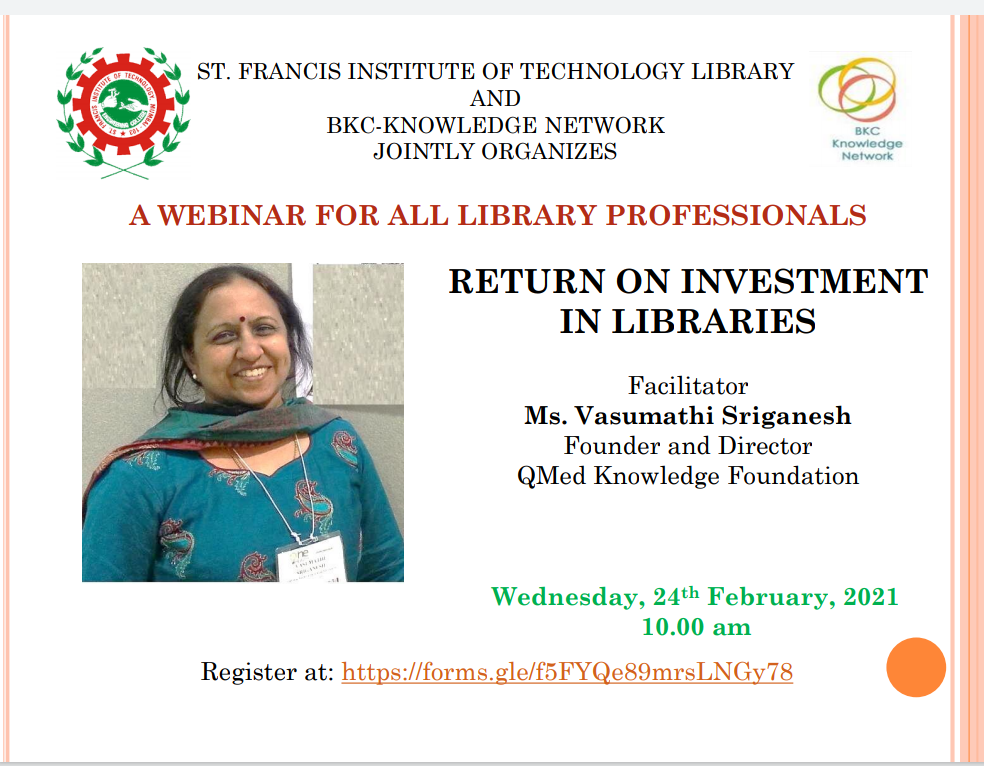
Webinar on Return on Investment in Libraries


People generally prefer to live nearby public libraries. Not because they would have access to enough books and Information alone. Libraries are a culture in themselves. They are a witness to history and are ever evolving places. Generations have passed but libraries will still carry a legacy. It's a proven fact that libraries are important for mental wellness. But do we the worth of these libraries? Every penny should count. We invest a heavy amount in books, journals and databases. But do we make forced choices, informed choices or sound choices? We understand return on investment in libraries in terms of usage such as number of books issued, number of footfalls and number of articles downloaded.
There is much more to it. What is it? How do we calculate? How to know the worth of my library?
Exactly all these questions will be answered by our Resource Person - Vasumathi Sriganesh.
Do join us for an interactive  webinar on 24th February, 2021 at 10 am.
Please find attached herewith the poster and the Registration link.

Friday, 5 February 2021

You're an awesome Librarian! But does the world know it?

 Part Two: Move Around

You're an awesome Librarian! But does the World know it?

Designing or re-arranging library spaces calls for an understanding of the students' varying needs and demands - both individually and as a group.
We generally arrange books class number wise as per the Dewey Decimal Classification. Well, I am not asking anyone to change this! But there may be a few changes here and there, might add that extra flavour to our library.
Re-arranging furniture is a good idea but not always feasible. Colouring the library with vibrant and extravagant colours is another option, although it will bite into our budget.
Here are some of the things that we have been doing in our library:
  • Re-arrange existing tables periodically, thanks to our huge space. Amusing as it may seem, but we display all our red colour books in our show-cases in the month of February (Valentine's Day = Love for Books)
  • Faculty publications such as books are sometimes arranged on the Display Rack and at other times on a table which says - " I bet you know them".
  • Many of you would know that B.E. students (Final Year of Engineering) need to submit a project report as part of their degree course. we request respective departments to share with us the "Top Three Best Projects" every year. We then compile these with abstracts and keep them on the table saying "Best Project Reports" with the group photo of the students, if possible. Students actually flock to see their seniors projects.
  • If library wall space is limited, then convert the back side of that periodical rack into a lovely wall journal. May be you can utilize this space for:
  • 1) Feedback about library
  • 2) Novel Idea for library
  • 3) A Quote (Quotations) Wall
Nowadays, people live a very busy life. We do not have time to read the book reviews available on Amazon or GoodReads. We go by the number of star ratings. Taking this forward, the story book shelf (novels and classics) which are mostly read can be grouped together on a centre table in the library and displayed with a 5-star rating. If you are a creative nerd, you can have short one-liners from these books embedded into bubbles or cut-outs which can be easily pinned to the books using cloth-pins.

With libraries becoming a hub of all activities, there are few more ways to redesign our libraries. Some of them are:
  • Coloured Zones incorporated with IT facilities
  • Makerspaces having 3D printing facilities
  • Interview Cubicles: These may be considered as very useful for students who have to appear for online interviews as part of their recruitments but do not have the added advantage of high bandwidth.
  • Research Space: An area recognized specially for research scholars which includes a Desktop / Laptop space, charging points, baggage area etc....can be likened to a personal space in the library.
  • Idea Space: An area to discuss the feasibility of a project in a group, basically for brainstorming.
Cite as: 
Bhange, C., 2021. 
You're An Awesome Librarian! But Does The World Know It?. [online] Innovating Libraries. Available at: <https://chinmayeebhange.blogspot.com/2021/01/youre-awesome-librarian-but-does-world.html>